
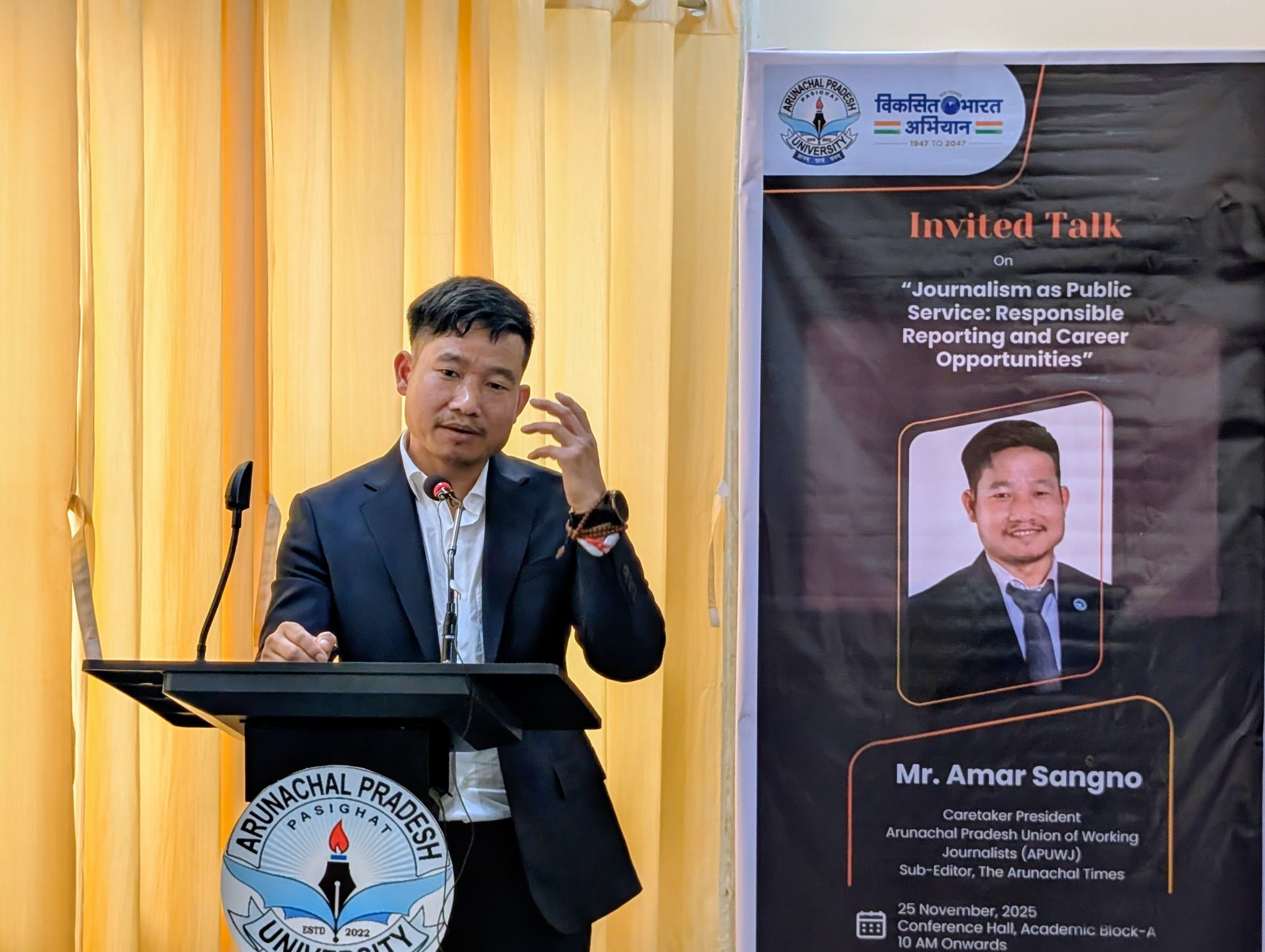
PASIGHAT, Nov 25: “Repeat a lie often enough, and it starts sounding like the truth — the illusion of truth. But journalism must rise above that. It must serve the public, not become the mouthpiece of any authority or interest group,” said senior journalist Amar Sangno.
Addressing students during an invited talk on “Journalism as Public Service: Responsible Reporting and Career Opportunities” at Arunachal Pradesh State University (APU) here Tuesday, he cautioned that in an age where “anyone with a lapel mic and a smartphone claims to be a journalist,” the core duty of the profession remains unchanged: to present credible, verified information to the public.
Sangno, who is now Arunachal Pradesh Union of Working Journalists (APUWJ) caretaker president-cum-The Arunachal Times sub‑editor, spoke extensively on media ethics, misinformation and evolution of journalism in the state.
He congratulated APSU for establishing Mass Communication department (MCD), calling it “a timely step that will strengthen state’s media ecosystem.” He also launched official jersey of the MCD.
APU Vice Chancellor Prof. Tomo Riba, speaking as chief guest, highlighted indispensable role of responsible journalism in a democratic society. The media must function as “a mirror that reflects truth, not a tool that amplifies distortion,” he said.
Emphasising importance of media literacy, he urged all to remain informed, discerning and critically aware of information they consume.
Praising the MCD, he expressed hope that it would “grow into a robust academic unit and contribute significantly to the media landscape of the state,”
Registrar Narmi Darang underscored the importance of ethical conduct in journalism, urging students to uphold accuracy, fairness, and accountability. He noted that the rapid expansion of digital media has made responsible reporting more crucial than ever.
Sangno, during technical session, shared insights from his years of experience, discussing newsroom challenges, the rise of digital platforms, and the future of journalism in the state.
He encouraged students to cultivate curiosity, courage, and compassion—qualities he described as essential for meaningful journalism.
He also clarified that mass communication offers diverse career paths beyond reporting, including public relations, digital content creation, advertising, and research.
Students engaged actively during the interactive segment, asking questions on yellow journalism, gatekeeping, ethics, and career prospects. Sangno responded with practical examples and urged them to “be part of the solution, not the noise.”
MCD assistant Prof Dr. Kombong Darang lauded Sangno for his candid and insightful engagement.
The session had broadened students’ understanding of the media profession and reaffirmed the department’s commitment to nurturing informed communicators, he added.
HoD in-charge Dr. Prem Taba said earlier that beginning the MCD’s academic journey with experienced professionals was intentional.
“MCD is young, but steadily taking shape within the academic framework. I wanted our students to learn from seasoned practitioners like Sangno, whose years of experience offer lessons no textbook can fully capture,” he said.
He expressed hope that the department would grow manifold in the coming years and contribute meaningfully to the state’s media.


 20
