
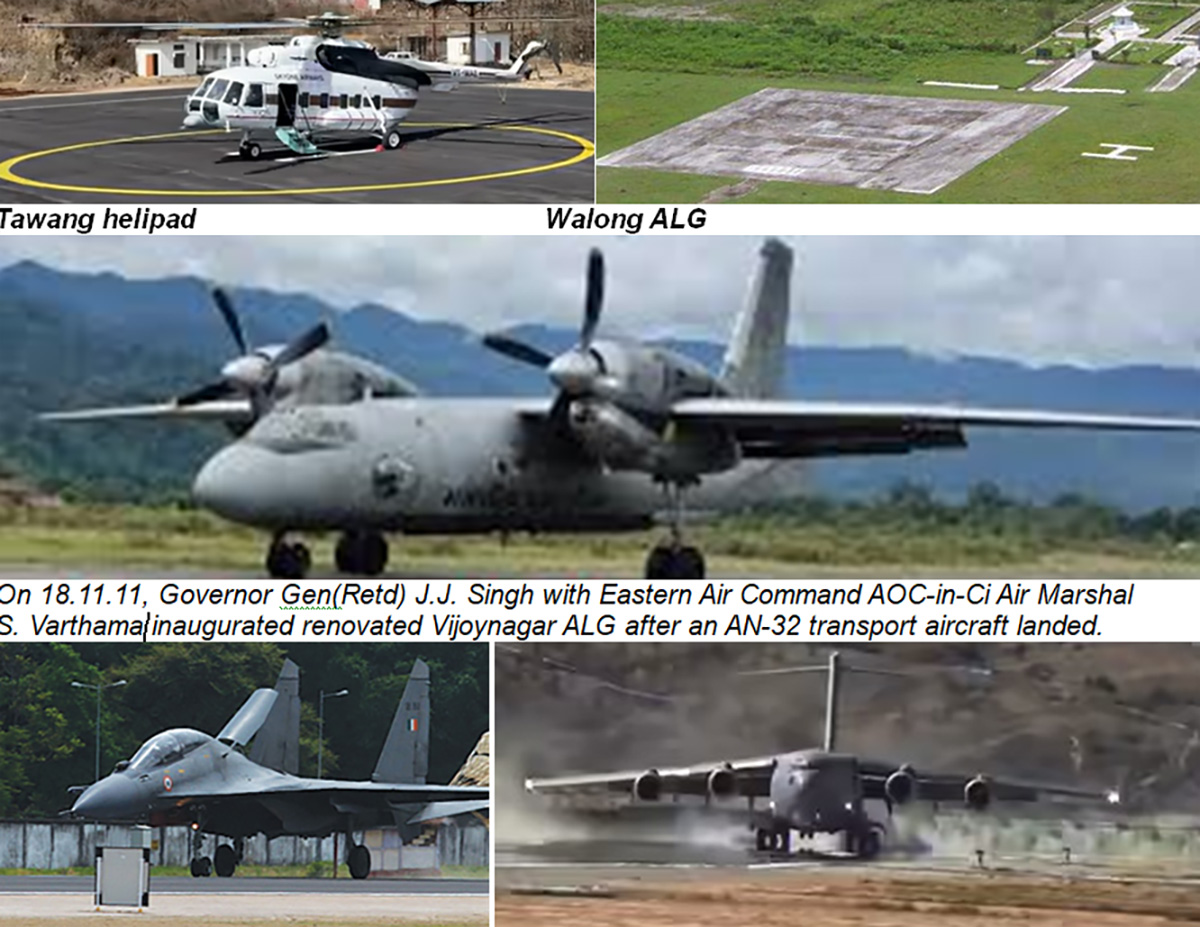
On 19.08.16, Sukhoi-30MKI fighter jet landed at Pasighat ALG & on 03.11.16, C-17 Globemaster transport aircraft landed at Mechuka ALG. C-17 commonly performs tactical and strategic airlift missions, transporting troops and cargo medical evacuation and airdrops throughout the world.
Beyond the Horizon
By Pradeep Kumar
The ill-treatment ofUK-based financial expert Pema Wang Thongdok from Rupa in Arunachal Pradesh, who was detained for 18 hours at Shanghai Pudong Airport on November 21, by immigration officers of China clearly proved Beijing’s ‘Dog-tailed policy’ towards Arunachal Pradesh.
The adage (You can’t straighten a dog’s tail), means it is impossible to change someone’s fundamental nature, ingrained habits or inherent character regardless of the effort applied, bodes well with China.
Chinese immigration officials, who refused to recognise her Indian passport, insisting that her birthplace Arunachal Pradesh is “part of China” and mocked at her to suggest that she should “apply for a Chinese passport”, are ignorant that Chinese troops were repelled by Indian soldiers in Yagtse area of Tawang sector in December 2022.
A Chinese PLA detachment had attempted to breach a position along LAC, but was pushed back by Indian troops using clubs and stones. This clash was the most serious military engagement along the non-demarcated border since the 2020 Galwan Valley incident.
Indian Army was defeated in month-long Sino-Indian War since October 20, 1962 as Indian Air Forces (IAF) was not pressed into service.Many military experts, including present current Chief of Defence Staff General Anil Chauhan, who believes that using the IAF in an offensive role would have significantly changed its outcome.
The consensus is that IAF air power could have slowed or even halted the Chinese advance by attacking supply lines and troop concentrations, providing the Indian Army crucial time to prepare. The IAF was restricted to support and logistics roles at the time, which was a major factor in India’s defeat.
Slowing the offensive: IAF aerial bombardment could have disrupted the Chinese advance, potentially slowing it considerably and forcing them to divert resources to defending their own logistics.
The IAF could have targeted Chinese supply lines, which were difficult to sustain over the rugged terrain, potentially cutting off ammunition and other crucial supplies to front-line troops.
A successful air campaign would have given the Indian Army more time to organize and defend its positions, rather than being overwhelmed by the speed of the Chinese assault.
The use of air power would have had a significant psychological effect on Chinese forces, potentially boosting Indian morale and degrading enemy combat effectiveness.
The decision not to use the IAF offensively was a political one, reportedly influenced by Prime Minister Jawaharlal Nehru, who feared a wider conflict and considered air power an “escalatory” measure.
There was a significant concern that using the air force would be seen as an aggressive act, potentially leading to an even larger war with China and its allies.
Realising that China is not trust worthy, the Cabinet Committee on Security in June 2009 had approved taking over of eight existing ALGs at Along (Aalo), Mechuka, Pasighat, Tawang, Tuting, Vijaynagar, Walong and Ziro by Indian Air Force (IAF).
The IAF took over the airfields from the Airports Authority of India (AAI) in stages, for example, acquiring the Ziro airfield in August 2010. The IAF began a comprehensive plan to upgrade by renovating abandoned World War II-era airstrips that had fallen into disuse, some since the 1962 Sino-Indian War.
The upgradation involved developing full-fledged paved runways capable of handling modern aircraft, like C-130J Super Hercules transport aircraft and even C-17 Globemaster III; constructing associated infrastructure, including Air Traffic Control (ATC) towers, aprons for ground maneuvering, perimeter roads, and security walls and allowing dual use by civilians and military to facilitate tourism and connectivity to remote areas under the UDAN scheme.
The eight ALGs have since been operationalized, with trial landings of large transport aircraft and even Su-30MKI fighter jets occurring at some locations to validate their capabilities. The upgrades significantly enhanced the IAF’s operational reach and logistics support in the strategically important Eastern sector of the border, particularly along Indo-China border.
Moreover, the ongoing 1,748 km-Arunachal Frontier Highway (AFH) or Bomdila-Vijaynagar Highway, (NH-913) to run as close as 20 km from the LAC would be a befitting safeguard against aggressive PLA.
Arunachalees are staunch patriots which Thongdok proved by her view: “Indians should stand united and with one another. “I don’t even live in India so any action that the Indian Govt takes will be for the benefit & pride of my fellow Indians and Arunachalees living here, not mine. We are one nation; we stand for one another.”


 20

