
Sooner, the better!
About 200 patients are going dialysis daily in 11 hospitals across Arunachal Pradesh. When the present Govt is people-centric, it should make the facility, installed under the supervision of an expert team from UK’s Winchester University’s Prof Atul Duggal and Delhi’s Ram Manohar Lohia Hospital’s Dr Arun Kapoor with well trained staff, functional to save most of the patients. The GoAP help under CMOTS to transplant kidney, liver & bone marrow at TRIHMS is enough. But this help would be too less for availing such facility in any outside hospital. Should the lone medical college & hospital earning one after another national glory, remain behind?
By Pradeep Kumar
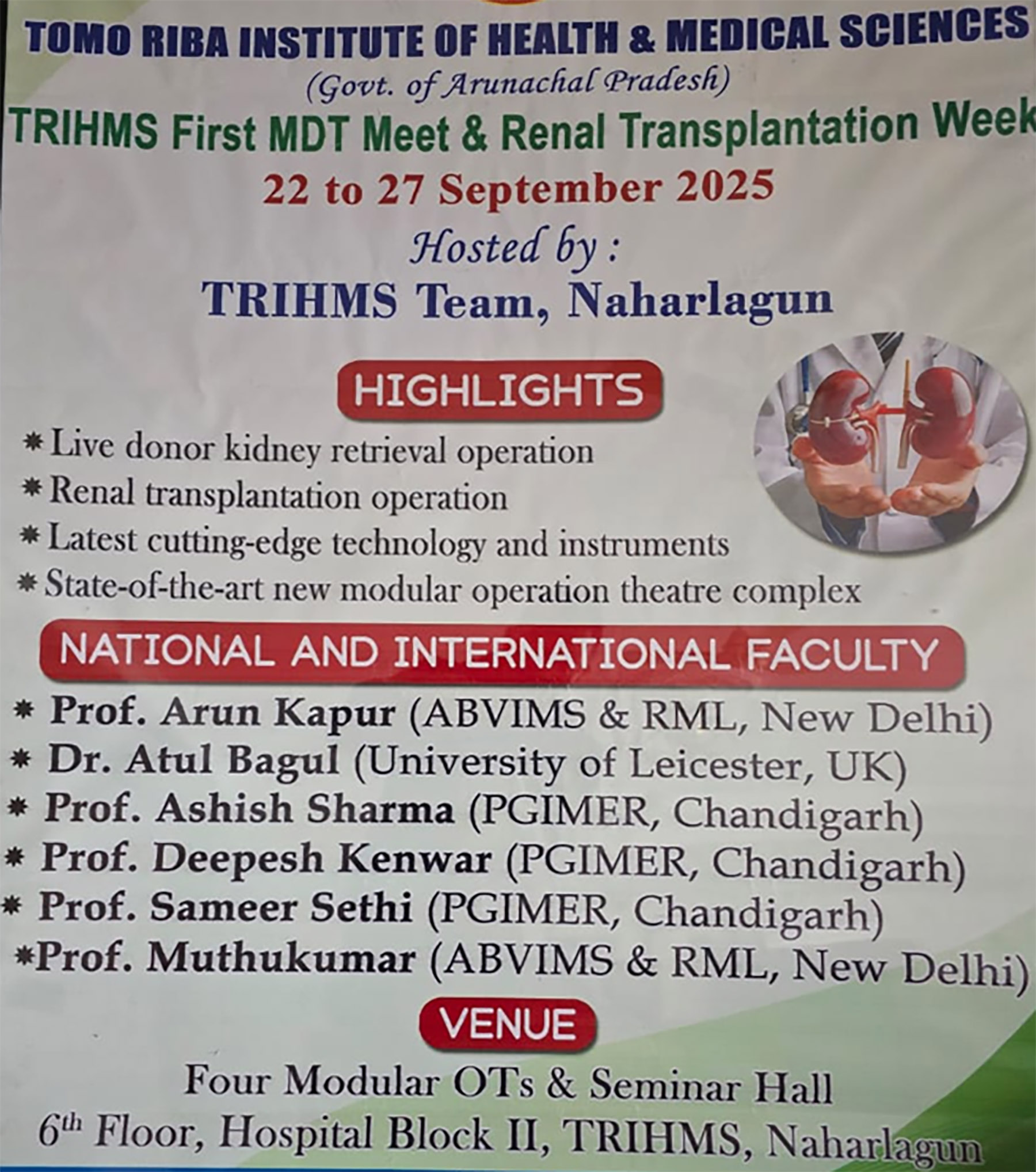
NAHARLAGUN, Dec 26: The kidney transplantation system, worth few crores installed in TRIHMS, scheduled by then director Dr Moji Jini for inauguration after first MDT meet and Renal Transplant week (September 22-27, 2025), was abruptly halted and one wonders why the system is still defunct after Dr Jini demitted office on 19.09.25?
Kidneys remove wastes and extra fluid from body, remove acid produced by the cells of body and maintain a healthy balance of water, salts and minerals—such as sodium, calcium, phosphorus and potassium—in your blood for a healthy body. Damaged kidney is transplanted at a higher cost.
In India, it costs ₹1.5 lakhs (Govt hospital) to ₹15 lakhs (private hospital), while in the US it costs over ₹2-3 crores) due to factors, like hospital (private vs. public), city, surgeon’s expertise, donor type (living/deceased), required tests, post-op care, and lifelong immunosuppressant medications, with Govt schemes offering aid for the needy.
CMRRS relaunched as CMOTS: CM quantifies GoAP help
for transplanting kidney, liver, bone marrow at TRIHMS
In fact, in his presidential address to first governing body meeting of Chief Minister’s Organ Transplant Society at Itanagar on 22.07.25, Chief Minister Pema Khandu, in his presidential address, had said: “Treatment alone isn’t enough. Real progress is when people don’t fall sick in the first place. We have to change how we think about healthcare, because a healthy society doesnot start in the operating room. It starts at home, in our communities, in how we live. That’s why the Health Department must focus on prevention, not just treatment. And that means real investment in awareness, education and lifestyle change.”
The Chief Minister’s Organ Transplant Society was to implement newly launched Chief Minister’s Organ Transplant Scheme (CMOTS), an expansion and relaunch of earlier Chief Minister’s Renal Replacement Scheme (CMRRS) and the CM had emphasized the importance of a holistic approach to healthcare.
The CMRRS since its inception in last seven years has successfully supported over 200 kidney transplant patients across the state. Building upon this success, the CMOTS broadened the scope of support to include liver and bone marrow transplants in addition to kidney transplants now.
Under the new scheme, the GoAP will provide financial assistance up to ₹10 lakh for kidney transplants, ₹15 lakh for bone marrow transplants and ₹20 lakh for liver transplants.
The CMOTS launch indicated the GoAP’s continued commitment to accessible and equitable healthcare for all to ensure critical life-saving transplants are within reach of every eligible citizen. (CMO)This announcement came after Health & Family Welfare Minister Biyuram Wahge along with MLA-cm-advisor to H&FW Minister Dr Mahesh Chai and state’s lone medical college-cum-hospitalTRIHMSdirector Dr Moji Jini on July 11 had visited Chandigarh-based Postgraduate Institute of Medical Education and Research (PGIMER) to strengthen ongoing collaboration between two institutions.
The visit aimed to reinforce efforts to establish a robust renal transplant facility in the state and to request continued academic and technical support from the PGIMER. The team held constructive discussions with PGIMER Director Prof. Vivek Lal and a panel of expert doctors focused on technical roadmap, phased implementation strategy to ensure safe and effective transplant protocols tailored to the state’s unique healthcare landscape.
The visit also saw second batch of healthcare professionals of the state being trained in the PGIMER. A previous team comprising doctors and transplant coordinators had undergone extensive training under the institute’s mentorship. The current batch continues this partnership, ensuring capacity building and skill development for establishing a self-sustaining renal transplant ecosystem in the state.
“I have come here to thank you all. You have helped me accomplish such a significant thing. Our patients struggle to access transplant facilities and it is time we bring this critical service to our state. The PGIMER is a national institute of excellence and we are here to seek your mentorship, your support and your experience to help us build a transplant facility in Arunachal Pradesh,” the minister had said.
Lal elaborated on the pathways for in-service doctors from the state, including both sponsorship-based postgraduate training and short-term observer programmes that offer immersive exposure without interrupting essential services back home. Such dual-mode training strategies have already proven successful in other partnerships, including with the Indian Army. They are now being extended to the state, he said.
“It is truly remarkable that you have travelled from Arunachal Pradesh bypassing formal protocols, just to spend maximum time to understand our systems. Your dedication to improve health services of your state is exemplary. Thus, PGIMER stands committed to supporting Arunachal Pradesh with structured training programs, observer opportunities and shared clinical protocols,” Director Lal said to laud Wahge’s commitment. (to continue)


 20

