
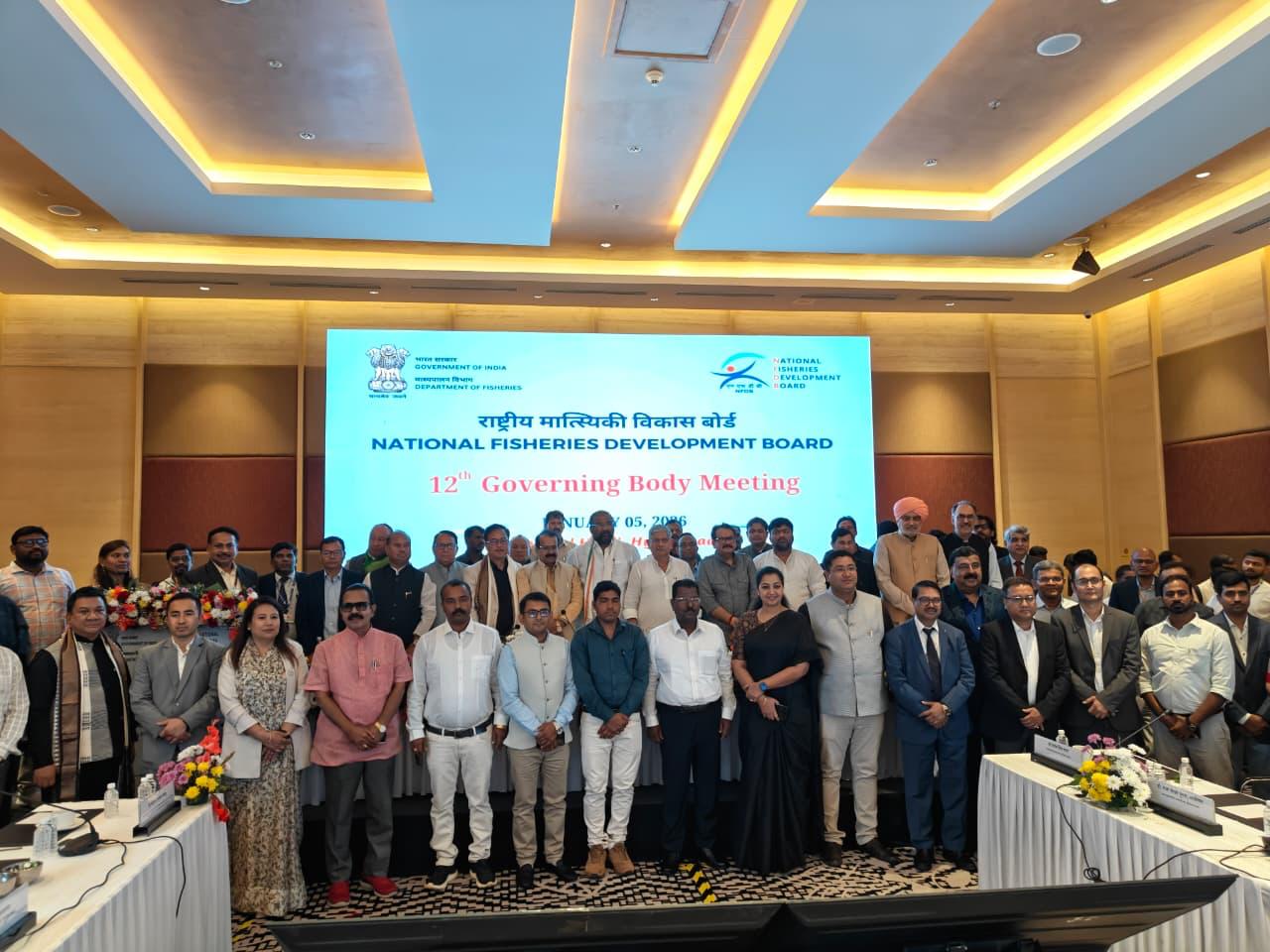
HYDERABAD, Jan 05:Union Animal Husbandry and Fisheries Minister Rajiv Ranjan Singh, chairing 12th governing body meeting of National Fisheries Development Board (NFDB) here on Monday, Reviewed progress of fisheries and aquaculture development in India.
In his address, he stressed importance of optimal and timely utilization of sanctioned fund and directed all states and UTs to ensure early completion of ongoing projects under flagship schemes, particularly the PMMSY. He emphasized that efficient implementation and outcome-oriented use of resources are critical for enhancing fish production, improving livelihoods of fishers and fish farmers, and strengthening the fisheries value chain.
The meeting, attended by MoSs S. P. Singh (Animal Husbandry and Fisheries) Baghel, George Kurian (Fisheries); Tripura, Mizoram, Haryana, Sikkim and Puducherry Fisheries Ministers; senior fisheries officers of states/UTs, deliberated key agenda relating to fisheries development, infrastructure creation, sustainability and region-specific priorities. States shared their experiences, challenges and best practices in implementation of fisheries schemes.
Arunachal Pradesh Fisheries Minister Gabriel Denwang Wangsu, supported adoption of “Amrit Sarovar” by fisheries department for fish farming, proposed by Tripura Fisheries Minister.
Convergence of fisheries activities with Amrit Sarovar would significantly boost inland fish production while creating additional livelihood opportunities for rural communities, Wangsu reasoned and urged for due consideration.
He also sought establishment of an NFDB regional centre in Arunachal Pradesh and assured full logistical support by the GoAP.
The meeting gave special focus on cold-water fisheries with suitable relaxations under PMMSY for hill and border states, including higher unit costs, flexible norms, and cluster-based implementation.
Strengthening infrastructure and seed security through expansion of carp and trout hatcheries, brood banks, local feed production units and development of farming clusters.
Conservation and sustainable utilization of indigenous fish species through hatcheries, river ranching, and stock enhancement programmes.
Development of value chain and post-harvest infrastructure, including mini feed mills, mobile ice plants, cold storages, insulated transport, and value addition units. Resource mapping and digitization using geo-spatial technologies for effective planning.
The meeting reaffirmed collective commitment of the Centre and states to work in close coordination for holistic and sustainable growth of the fisheries sector. (PRO)


 20

