
By Pradeep Kumar
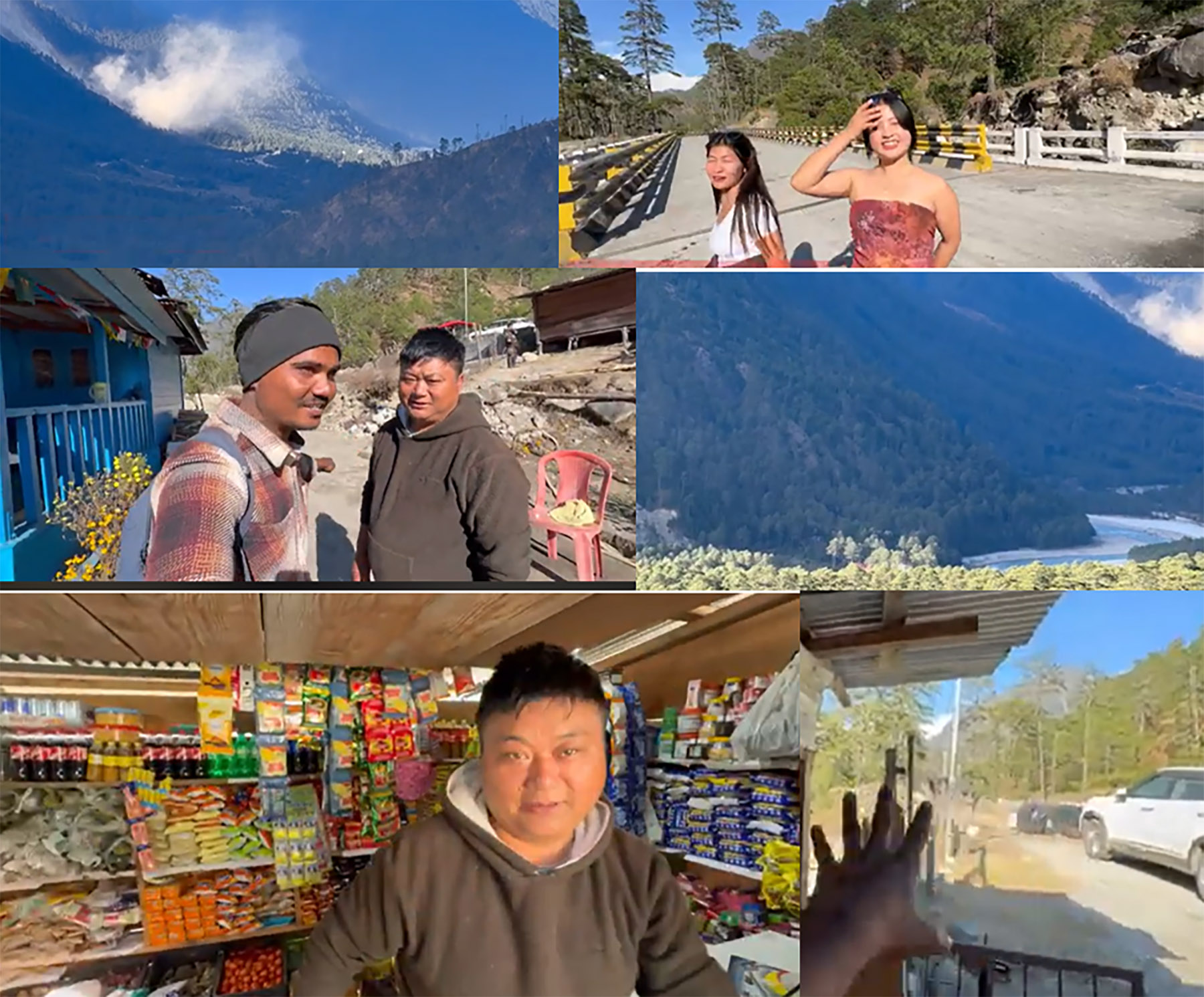
ITANAGAR, Jan 24:Situated 40-km from Walong and nestled in a picturesque valley amidst pine-clad lofty mountains, the sleepy and non-descript Kaho village is situated on the left bank of the mighty Lohit River that flows in its crystal-clear greenish colour in Kibithu circle of Anjaw district. Kaho translates into the ‘dwelling place of many priests’.
Kaho is a remote, border village, recognized as the easternmost or “first,” village of India in of Arunachal Pradesh in November 2022, located near China border.
Inhabited by about 17-18 families of Meyor community, it is known for its scenic beauty, Buddhist culture and strategic importance, having played a key role during the 1962 Sino-Indian War. The village is turning into a tourist hub as a tourist interacting with a local as seen in the picture.
Situated in Kibithoo block of Anjaw district, 10-km from the Line of Actual Control (LAC), the village is surrounded by high mountains and is near the Lohit River, which flows into India from Tibet.
The village has a very small population with roughly 65–80 residents belonging to Buddhist Meyor tribe and known for being extremely hospitable and patriotic
The village has strong ties to 1962 India-China war, and residents are noted for their bravery during that time. Kaho is emerging as an offbeat tourist destination for its pristine landscape. It is accessible via a challenging, scenic drive from Tezu or Dibrugarh with the nearest major town being Walong, which boasts of a 1962 War memorial.
Buddhist inhabitants depend on agriculture, horticulture and animal husbandry for a living. They practice both jhum and wet rice cultivation.
Chor, a variety of large cow, is their main domesticated animal that fetches milk and is also used to plough their fields. The village boasts of a primary school and a health sub-centre. There is a heavy presence of security forces on the periphery of the village for obvious reasons and civilians are strictly prohibited from venturing beyond the village.
The villages are small and their population is sparse. The Meyors celebrate a number of festivals and rituals every year. Lanchhut is their main festival and it is celebrated in January. They also celebrate the New Year festival Losar in December and February.
Almost all the Meyors can speak the Miju Mishmi dialect because of their proximity to their neighbouring tribe. The Meyors are mild and hospitable by nature and are patriotic to the core. History says they assisted the Indian army during the Chinese aggression in 1962. In the past, the villagers of Kaho used to build their dwelling houses with pinewood. Even the roofing, now replaced by tin, used to be of wood.
There are Meyors in China also bordering Kaho village. Some of the Meyor villages in China are Rungtut, Rungmat, Rungjit, Sangu, Samar Latam and Rimathong. The economically beneficial border trade between the Meyors of India and China was prevalent until the 1962 conflict.
The life of the Meyors living in the borders is tough and unforgiving. With stiff mountains and harsh weather conditions, cultivation is an uphill task here.
The villagers are now starting to engage themselves in horticultural activities – kiwi grows very well here – to augment their source of income. They have also started exploring the opportunities and possibilities of growth in the tourism sector and have built a few home-stays to accommodate tourists.
Life in Kaho is simple, with limited connectivity, although the village is seeing improvements in infrastructure. Accommodation is available in basic, traditional homestays. But it is highly recommended to avoid visiting during the monsoon season (June–September) due to landslides.
There are inspection bungalows and home-stays at Walong and Kibithu that the tourists can avail. Dong, popular as the place that gets the first sunlight in India, is worth visiting for a hot spring.
Kaho being strategically located and the Meyor tribe being one of the smallest in terms of population, the village needs government intervention for more gainful schemes and also to help the people grow in all spheres of life.
Tourism holds great promises for the people of Kaho and adjoining villages of Kibithu and Walong circles. The GoAPmay initiate suitable steps to boost tourism there in order to engage the local people gainfully and improve their fragile economy.
One can reach the village via Walong, but it takes one-hour trekking to reach Dong Valley, which witnesses first sunrise of India. It drew global attention with Chief Minister Pema Khandu trekking himself to survey the area and launching maiden “Sunrise Festival” during 29.12.25, to January 02.01.26, which would be a colander event to boost tourism.


 20

