
- Academic visit soon: Prof Nayak
By Pradeep Kumar
RONO HILLS, Jan 27: Arunachal Pradesh, with highest languagediversity, considered”linguistic museum of India”, inhabited by numerous tribes and sub-tribes to create a unique, diverse cultural landscape, boasts of over 50 major languages and estimated over 200 distinct dialects belonging to Tibeto-Burman family, has drawn attention of Ireland in western Europe.
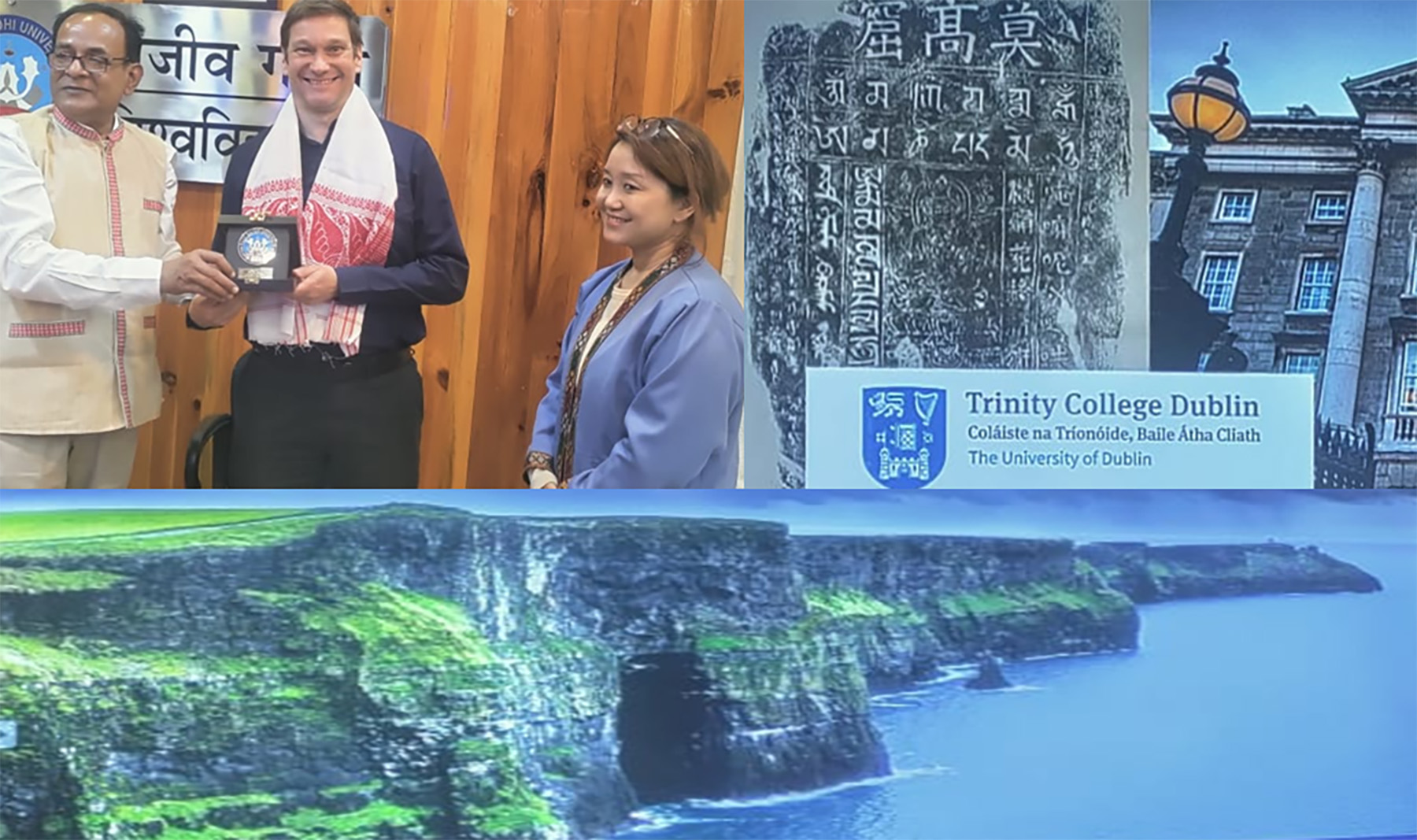
Prof Timotheus (Tim) Bodt, Associate professor (Asian Studies), Trinity College Dublin and deputy director of Trinity Centre for Asian Studies,University of Dublin, who had conducted in-depth research on Gonduk and Monpa languages of Dirang circle of West Kameng district under Lo-Rig project during 2012 to 2017, gave a presentation to Rajiv Gandi University (RGU) acting vice chancellor Prof SK Nayak on January 26 on the outcome of his research.
Prof Bodt, flanked by RGU’s Arunachal Institute of Tribal Studies (AITS) assistant Prof Lisa Lomdak, proposed collaboration between both universities. As Prof Nayak consented to co-authored, visit of academic staff and organize workshops and conferences in collaborationschemes and hinted at RGU’s provision for co-supervisor for PhD papers, Prof Bodt suggested to make a draft memorandum of understanding (MoU) for the needful. Prof Nayak also asked Dr Lomdak to apply under ‘visit of academic staff’ scheme, who nodded in affirmation.
Prof Bodt, who understands and fluently speaks in Monpa and endangered Gonduk languages, looks almost like an Arunachalee because of his Mongoloid feature. The confidence lit large over his face was testimony to what he does with commitment is perfect. Or else, he would not have landed here from his country, located about 8,000-km away.
“I was doing my research in Tezpur University under Prof Madhumita Bezbarua when I learnt about cultural and language diversity of North East India, Arunachal Pradesh in particular. My journey continues as there is vast scope for research on languages in this Himalayan state,” he told this daily in an exclusive interview after giving presentation to the VC.
In his detailed presentation earlier, Prof Bodt said that Ireland has emerged as a center of education and knowledge in South East Asia,but he of late has been focusing on India, being a vast nation with uncanny diversity of languages and cultures. He cited the example of lecture series with the help of Dublin’s Ramakrishna Vedanta Centre, attended by Indian Ambassador.
The expansion plan is a continuous process,he said and hinted at development of state-of-art Automation Speech Recognition methodologies and Language Documentation Software for low resume languages. Apps, books and dictionary would also be developed for digitalization of languages in future, he said.
Appreciating the decisions, Prof Nayak said that the AITS would join your transformation process and asked Dr Lomdak to take note of everything to act accordingly.
Ireland, rising above original Catholic and Irish ideology of itsfounder England Queen Elizabeth-II, has undergone sea changes during last 30 years, Prof Bodt recalled, adding Google and Meta have their offices there and paying astronomical salaries to their staff.
There are few universities – University of Galway, University of Limerick, Dublin City University (DCU), Maynooth University and RCSI University of Medicine & Health Sciences, which offer a wide range of short, under graduate, post-graduate courses, top-tier research-led programmes and PhD for international students, he said, adding the number of students in under graduate Japanese, Korean and Chinese is 100, 55 and 45 respectively.
Competitive spirit is the hallmark of the university, which offer numerous scholarships based on merits, he said, adding students of each course with pan-South East Asian faces prove it to be global platform for not only education but also exchange of ideas and sharing knowledge, he said with conviction.
Many institutions, including Council of Social Science Research &Science and Engineering Research Board, offer funds for research, Prof Bodt said and qualified the huge annual amount.
Dr Lomdak, responding to questions, said that the linguist had given his research paper which is used as a reference by the AITS to make him well known, but she was very happy to come in personal contact with him for the first time.
His academic association with RGU would continue. Who knows some students might go to Ireland for higher studies and conduct research to cement his ties further, she added with conviction.


 20

