By Special Correspondent
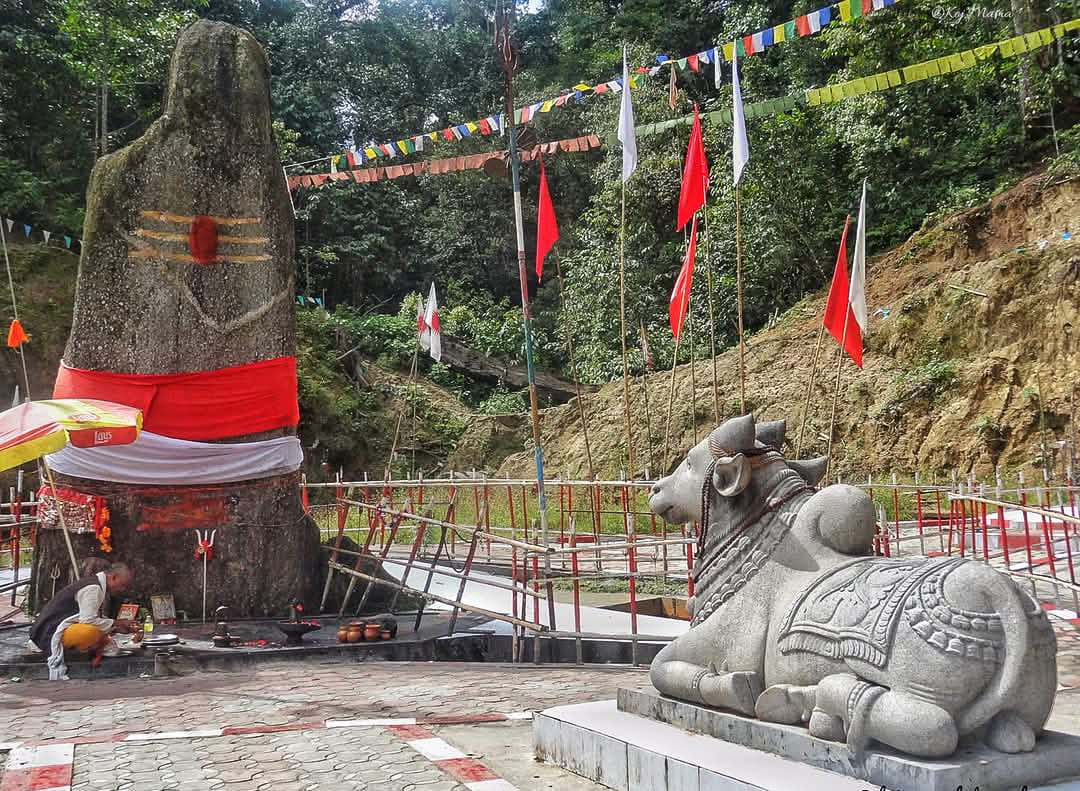
ITANAGAR, Feb 15: Thousands of devotees visited the Siddeshwar Nath Temple, one of the largest Shivalinga in India measuring 25 feet tall and 22 feet wide, discovered in 2000s in dense Kardo forest at a height of 5754 feet above sea level.
This ancient Lingam is mentioned in Shivapurana in its 17thchapter of the ninth section (Nava Khand ke Satrahwa Adhyaya) edition 1893 that the tallest Shiva Lingam will appear at a place which will be called Lingalaya.
The images of Goddess Parvati, Kartikeya on the right and Ganesha with his trunk towards the left are seen in the idol. The major attraction of this place is constant flow of water of Ganga Lake from the base of huge linga. Every year thousands of pilgrims visit this temple in the month of Sharvan, particularly on Shivaratri.
During this ongoing holy month of Shravan, this divine place not only offers spiritual peace but also connects all deeply with our rich cultural and natural heritage.
Maha Shivaratri is celebrated annually to worship the deity Shiva to commemorate the marriage of Shiva and Parvati and Shiva performing his ritual tandava dance. It symbolises overcoming darkness and ignorance” in life and the world. It is observed by remembering Shiva and chanting prayers, fasting, and meditating on ethics and virtues such as honesty, non-injury to others, charity, forgiveness, and the discovery of Shiva. Ardent devotees stay awake throughout this night by lighting earthen lamps. The festival is believed to have originated in 5thcentury BCE.
Balasore: Odisha is popularly known as “Land of Temples” as it houses some of the oldest and medically spiritual temples in India and a storehouse of Odiya culture. Bisheshwar Mahadev Temple in Chand Mari Padia, saw large number of devotees making a beeline to worship Lord Shiva.
Lord Shiva, a principal deity in Hinduism and part of the Holy Trinity (Trimurti), translates to “The Auspicious One” or “Benevolent”. While Brahma is the creator and Vishnu the preserver, Shiva is the destroyer and transformer.
As a Supreme Being in Shaivism, he represents the destruction of impurities, transformation, and cycle of creation allowing for new creation and evolution.
He represents the primordial Self and the foundational, empty space (“that which is not”) from which all existence emerges. He is the ultimate master of yoga, meditation and arts. Despite his role as destroyer, he is viewed as inherently benevolent, protecting the innocent and removing evil.
Frequently depicted with a third eye (insight/wisdom), a crescent moon (time), a trident/trishula (three powers of knowledge, desire, and action), and a damaru (rhythm of life). His tandava dance symbolizes the cosmic cycles of creation, preservation and destruction.
Shiva, associated with his consort Shakti (Parvati) and sons Ganesha and Kartikeya, is worshipped in both human form and as the Lingam, which represents the formless, infinite nature of the divine. Known by 108 names, including Mahadeva (“Great God”), Rudra and Shankar, he is considered the Adiyogi and meditating at Mount Kailash.
The discovery of Shiva Lingas across the globe—ranging from Southeast Asia to Europe and Africa—is frequently cited by researchers and enthusiasts of ancient history as evidence of a widespread, ancient Vedic culture, justifying the concept of Shiva as “Vishwa” (the Lord of the Universe) or “Vishwanatha”. These findings suggest that the worship of this symbol was not confined to the Indian subcontinent.
Ireland: The Stone of Destiny, also known as the Lia Fáil, is a standing stone located at the Inauguration Mound on the Hill of Tara.
Vietnam: Archeologists recently discovered a monolithic sandstone Shiva linga from the 9th century CE, at the remains of Hindu temples in Quảng Nam province.
Italy: This linga is currently on view in the Etruscan Museum at the Vatican in Rome. During excavations many such “meteoric stones mounted on carved pedestals”, have been discovered in Italy. Some say that many lingas are lying buried in the Vatican’s massive walls and numerous cellars.
Japan: The famous Toganji Temple in Nagoya, Japan, has a Shiva-Linga and shrine dedicated to Goddess Sarasvati, who is honoured in a festival in the form of Benzaiten. The Shiva Linga was built in 1532.
South Africa archeologists have found a 6000-year-old Shiva Linga made of hard black granite stone in Sudwara cave and were astonished as to how the Shiva Linga survived and remained intact so long.
Harappa: In 1940, archaeologist M.S. Vats discovered three Shiva Lingas at Harappa, dating over 5,000 years old. This rare ancient Shiva Linga of grey sandstone was excavated from the sitein situ. Six lingams were found along with some tiny pieces of shell, a unicorn seal, an oblong grey sandstone block with polished surface, five stone pestles, a stone palette and a block of chalcedony.


 20