
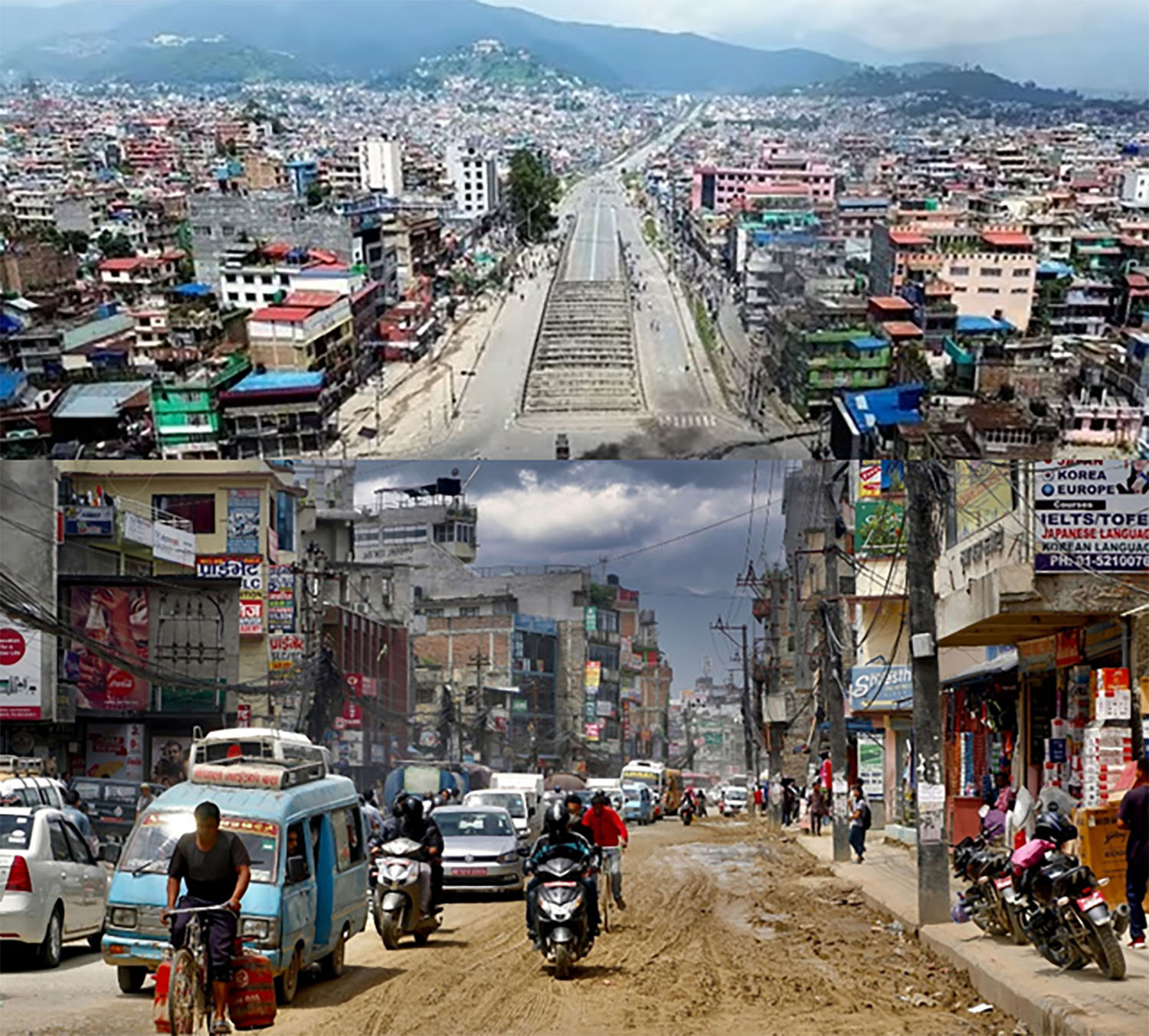
Beyond the Horizon
By Pardeep Kumar
Nepal,officially Federal Democratic Republic of Nepal,situated in the Himalayas, including parts of Indo-Gangetic Plain, is a landlocked South Asian country, bordering Tibet of China to north and India to south, east and west while Siliguri Corridor narrowly separates it narrowly from Sikkim state besides Bangladesh and Bhutan.
Nepal has a diverse geography, including fertile plains, subalpine forested hills and eight of the world’s 10 highest mountains, including Mount Everest, highest on the Earth. Ita capital Kathmandu is the largest city. Nepal is a multi-ethnic, multi-lingual, multi-religious, and multi-cultural sovereign state withNeplai as its official language.
The Himalayan branch of ancient Silk Road was dominated by traders of Kathmandu Valley. The cosmopolitan region developed distinct traditional art and architecture. By 18thcentury, Girkha Kingdom achieved unification of Nepal and Shah dynasty established Kingdom of Nepal and later formed an alliance with British Empire, under its Rana dynasty of premiers. The country was never colonised but served as a buffer state between Imperial China and British India.
Parliamentary democracy was introduced in 1951 but was twice suspended by Nepalese monarchs, in 1960 and 2005. The Nepalese Civil War in 1990s and early 2000s led to establishment of a secular republic in 2008, ending world’s last Hindu monarchy.
Nepal Constitution, adopted in 2015, affirms the country as a federal parliamentary republic divided into seven provinces. In September 2025, protest against social media ban, economic inequality and corruption caused riots, resulting in casualties and the resignation of the prime minister.
First modern humans had arrived on the Indian subcontinent from Africa 55,000 years ago, where they had earlier evolved. The earliest known modern human found in South Asia dates back to about 30,000 years ago.The oldest discovered archaeological evidence of human settlements in Nepal dates to the same time.
But Nepal’s economy is largely driven by agriculture, services, industry & tourism. Agriculture is the main source of livelihood for majority population, while service sector including trade, transport and communications has become increasingly important. Hydropower, IT and manufacturing sectors with Govt support years have shown growth potential, to attract investment and improve infrastructure in recent. The country continues to pursue policies aimed at sustainable growth and regional economic integration.
Nepal’s foreign relations emphasise development assistance, trade partnerships, promoting peace and stability in South Asia.
Nepal appears in ancient Indian literary texts dating back to 4thcentury AD.By late Vedic period, Nepal was mentioned in various Hindu texts, like late Vedic Atharvaveda Parisista and in post-Vedic Atharvashirsha Upanishad. The Gopal Bansa was the oldest dynasty mentioned in various texts as the earliest rulers of the central Himalayan kingdom of Nepal. Gopalas were followed by Kiratas who ruled for over 16 centuries by some accounts. According to the Mahabharata, the then Kirata king went to take part in Battle of Kurukshetra.
Nepal visibly is a poor country now, whose economy was projected to grow 4.5% in FY25, up from 3.9% in FY24, despite significant natural disasters in late 2024. Growth is expected to be driven by increased domestic trade, hydropower generation and paddy production, according to the World Bank’s latest Nepal Development Update: Leveraging resilience and implementing reforms for boosting economic growth, released 03.04.25.
The report also forecasts that Nepal’s economy will grow at an average annual rate of 5.4% in FY26 and FY27, driven largely by the services sector.
Nepal’s royal family massacred
On 01.06.01, Nepal’s royal palace became the site of one of the most chilling massacres in modern history. Crown Prince Dipendra (in picture) killed nine members of his own family, including his parents and siblings, before shooting himself.
The royal family had gathered at Crown Prince Dipendra’s residence inside Kathmandu’s Narayanhiti Palace for a monthly dinner. It was a private affair—no aides, no bodyguards, only immediate relatives. Earlier in the day, Dipendra had followed his usual routine—attending office, inspecting a stadium and visiting a royal guru’s home with his parents. But those who interacted with him sensed unease. He remained quiet and didn’t eat much.
By evening, Dipendra had consumed a large amount of alcohol. He called his alleged girlfriend Devyani Rana, and after a tense conversation passed out. Relatives placed him in his room to rest. But shortly after, he emerged in full military uniform—armed with an MP5K submachine gun, an M-16 rifle and a pistol.
He walked into the dining hall, shot King Birendra three times, and then fired indiscriminately. Queen Aishwarya, brother Nirajan, sister Shruti and several other royals were killed. In all, nine people were murdered. Dipendra then shot himself in the head but survived in a coma—long enough to be declared king before dying on June 4.
The news of the massacre first spread through foreign media. Nepal’s state-run TV and radio remained silent, playing only sombre music and images of the palace. Grieving citizens shaved their heads and flooded the streets during the royal funeral. Questions swirled: What had triggered this unimaginable act? Who—or what—was responsible?


 20

