Beyond the Horizon
By Pradeep Kumar
India is home to nine distinct species of hornbills, with the highest diversity found in the NE region and the Western Ghats. These spectacular birds protected under Schedule-I of Wildlife (Protection) Act, 1972, are: 1) Great Hornbill (Buceros bicornis), largest species in India, found in the Western Ghats and the Himalayas; 2) Rufous-necked Hornbill (Aceros nipalensis), found in the NE and listed as vulnerable; 3) Wreathed Hornbill (Aceros undulatus), known for its, large size and found in NE forests; 4) NarcondamHornbill (Rhyticerosnarcondami), endemic only to small Narcondam Island in the Andamans;5) Malabar Pied Hornbill (Anthracoceros coronatus), found in the Western Ghats and Sri Lanka; 6) Oriental Pied Hornbill (Anthracocerosalbirostris), commonly found in NE and throughout Southeast Asia; 7) White-throated Brown Hornbill(Anorrhinusausteni), a rare species found in the NE forests; 8) Malabar Grey Hornbill (Ocyceros griseus), often seen in plantations but endemic to the Western Ghats; and Indian Grey Hornbill (Ocycerosbirostris), widely distributed throughout the Indian subcontinent.
The Narcondam hornbill is endemic to the Andamans, but a shrinking habitat is threatening its survival. Less than 249 survive in the wild.
Interestingly, Arunachal Pradesh is a crucial habitat for four major hornbill species- Great Hornbill (state bird), Wreathed Hornbill, Rufous-necked Hornbill, and Oriental Pied Hornbill,
primarily found in Pakke Tiger Reserve& Sanctuary (PTRS) and Namdapha National Park in Changlang district.
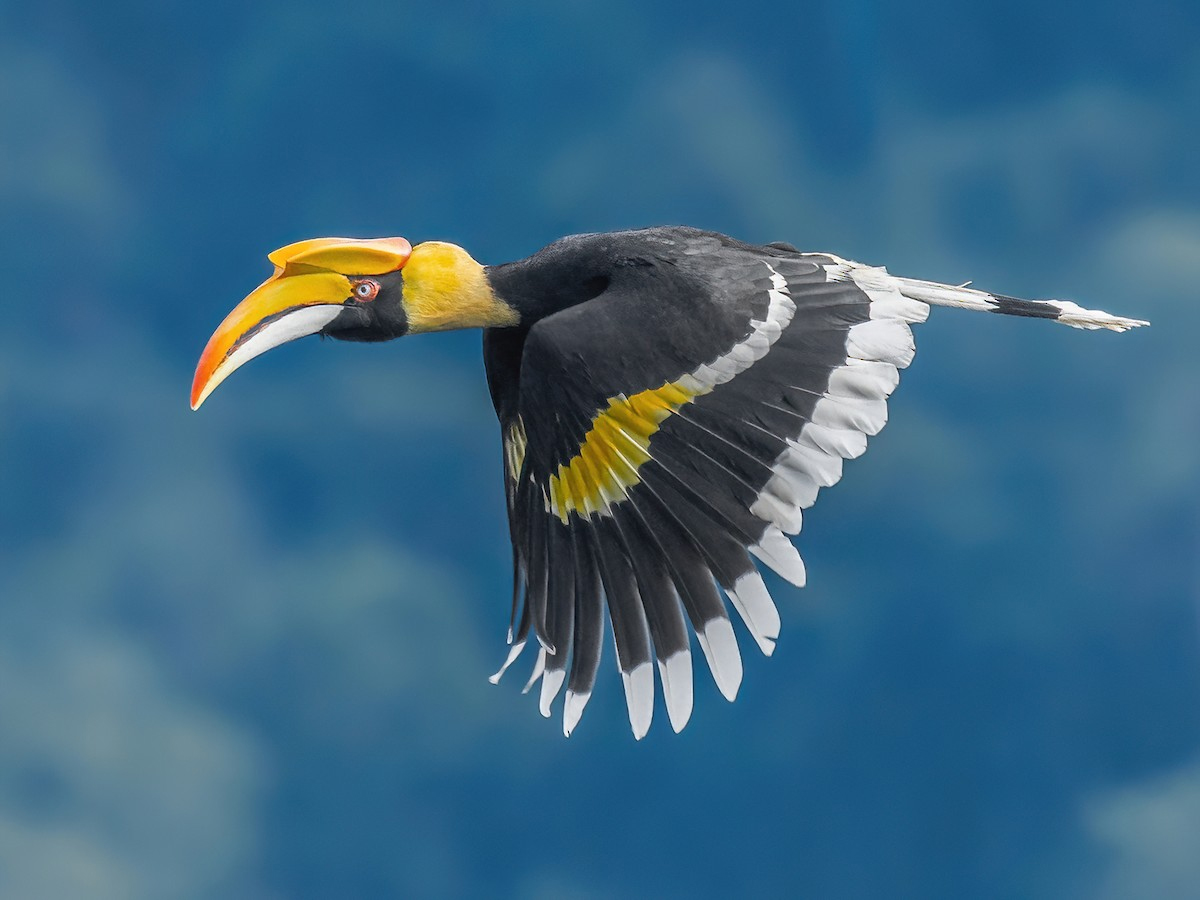
The Great hornbill, state bird of Arunachal Pradesh, have a black face, back and underbody, with two white bars on their black wings and a broad back tail band. The most striking feature is the huge black and yellow beak with an enormous concave-topped casque. It has a spectacular 5-foot wingspan, and often lands with a heavy ‘whoosh’ on tree branches.
The Nyishi tribe calls hornbill Paga or Poo, but in the past used to hunt to use its peak in traditional headgear, calledByopa or Pudum, as a cultural symbol of manhood and valour.But, Hornbill Nest Adoption Project was launched in 2012involving the Nyishis. They stopped hunting, used artificial peak given by Environment & Forest department for traditional headgear to turn protectors and changed the scenario. The PTRS in East Kameng district now boasts of 14 protected nesting areasto earn the sobriquets as ‘Hornbill hotspot’.
Moreover, hornbills are indicators of forest health for dispersing seedsand play a crucial role for the ecosystemto be known as “Farmers of the Forest”. The gigantic birds are glamorous, massive and do great service to the eco-system by dispersing seeds in their large beaks. The Malabar pied hornbill, also known as Lesser Pied hornbill, can grow up to 26 inches in size. Its black plumage is made patchy by a white belly, throat, tail sides and the trail of the wings. It’s the protruding large bill and the casque, along with the size that makes it stand out. The omnivorous birds have a rich diet of fruits, small mammals, birds, reptiles and insects that they can overcome with their size.
Thus, Pakke Paga Hornbill Festival, state’s only conservation festival, is celebrated annually in January to promote conservation of these birds, now protected by the community. The Hornbill Festival is also celebrated in adjoining Nagaland.
Hornbills are mostly seen flying away in groups, but also take dust baths to maintain feather health, remove parasites like mites, and absorb excess oil from their plumage. This behavior, often seen in open areas or fields, involves loosening soil with their beaks and flapping their wings to cover their bodies in dust. It is a crucial, high-energy maintenance routine.


 20