
Hydropower projects only
with people’s consent: CM
From Vishal Jain
NEW DELHI: Responding to a question, CM Khandu told this daily that Arunachal Pradesh is India’s hydropower powerhouse, boasting of over 58,000-MW of estimated potential—roughly 40% of the nation’s total to earn the sobriquet be “Hydropower Capital of India.”
But this land-locked state is surrounded by problematic countries, like China and Myanmar. Thus, the GoAP has been taking consent of the people, particularly those would be affected, for execution of any project. The GoAP has decided not to impose any decision on the people, he added.
In fact, state’s Siang Upper Multipurpose Project (SUMP), a national project, proposed to neutralise the impacts of China’s under construction massive 60,000-MW hydropower project on the Yarlung Tsangpo River (Brahmaputra) in Tibet, set to be the world’s largest one. It is apprehended that if China uses the dam as “water bomb” it would create catastrophe downstream in Arunachal Pradesh, Assam and Bangladesh.
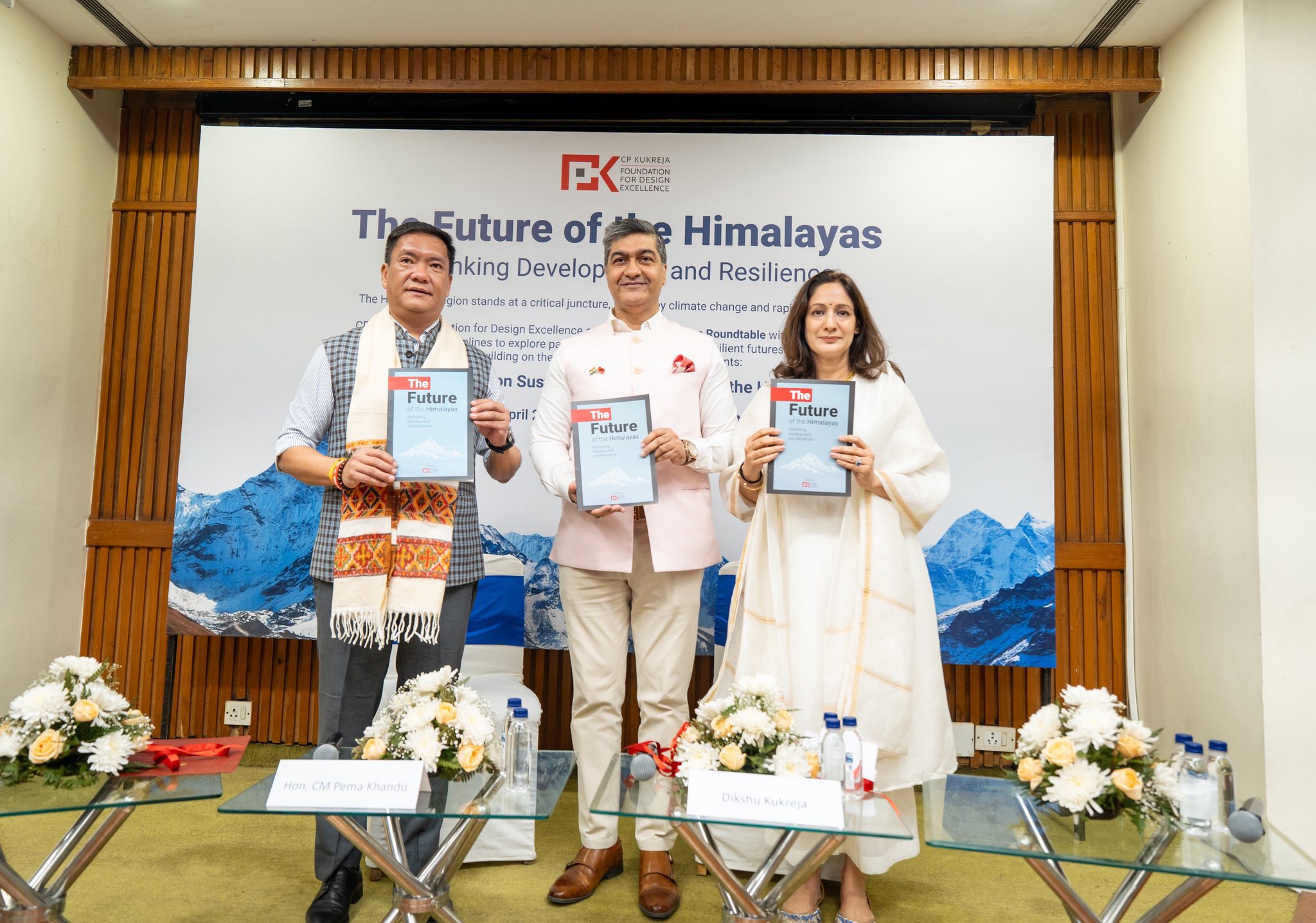
NEW DELHI, Apr 20: Arunachal Pradesh Chief Minister Pema Khandu, as chief guest, unveiled landmark White Paper, titled “The Future of the Himalayas: Rethinking Development and Resilience” of CP Kukreja Foundation for Design Excellence (CPKF) at India International Centre here on Monday.
The White Paper is the outcome of a multidisciplinary Himalayan roundtable convened by the CPKF, bringing together experts across governance, infrastructure, ecology, governance, engineering and social science to address increasing complexity of development challenges in the region.
At a time when climate volatility, rapid infrastructure expansion, and ecological fragility are converging, the publication underscores the urgent need to rethink prevailing development paradigms in the Himalayas. It highlights that Indian Himalayan Region has witnessed a 15–20% rise in extreme rainfall events since 1950s, accompanied by growing landslide risks and mounting stress on infrastructure systems.
The White Paper positions these, not as isolated occurrences, but as interconnected consequences of a deeper structural misalignment between development approaches and the realities of fragile mountain ecosystems.
It calls for a fundamental shift on how development in the Himalayas is conceptualised and executed. Key recommendations include transitioning from project-led interventions to system-level planning, aligning development strategies with watershed and basin-scale ecological processes, integrating scientific data into governance frameworks, and adopting terrain-responsive, context-specific infrastructure design. It also underscores the importance of recognising ecological carrying capacity as a critical, non-negotiable parameter.
Importantly, it reframes the Himalayas not as isolated geographies but as interconnected systems that directly impact nearly 1.3 to 1.5 billion people downstream across South Asia.
Introducing the White Paper, CPKF director Dikshu C. Kukreja said, “Development in the Himalayas must move beyond fragmented, project-led approaches to a more systemic and context-sensitive framework. Aligning infrastructure with terrain, data and long-term resilience is no longer optional—it is essential.
“Through this White Paper, we aim to bridge the gap between research and real-world implementation, and to catalyse a more resilient, context-sensitive and future-ready approach to Himalayan development,” he added.
CM Khandu, in his address, advocated a balanced approach to development in mountain states, highlighting that ecological preservation and economic progress must go hand in hand to ensure long-term sustainability. The Himalayas are at a critical juncture today, where the need for development must be carefully balanced with ecological sensitivity., he said.
While local communities seek growth and opportunity, it is essential that we adopt a calibrated, middle-path approach that safeguards this fragile ecosystem.
“The White Paper is a timely step in this direction. Much like complex challenges require a coordinated, multi-pronged strategy, development in the Himalayan region must be approached through an integrated framework—combining scientific assessment, responsible planning, sustainable infrastructure, community participation and strong policy alignment.
“It is important that institutions like NITI Aayog, along with policymakers, developers and global stakeholders work together in a mission-mode to embed long-term resilience and contextual understanding into every development decision,” the CM added.
Khandu was invited as Arunachal Pradesh with 79.33% of its total geographical area under forest boasts of over 500 rare orchids species, hosts 850–889 bird species, nearly two-thirds of India’s avian diversity, 850 bird species, 115 reptile species, 900 butterfly species and 210 mammal species, including all four major cat species—Tigers, Leopards, Clouded Leopards and Snow Leopards- one of the few places globally, is one of the 12 biodiversity hotspots in the world.
Positioned as a strategic framework rather than a prescriptive document, it identifies key structural gaps that continue to challenge Himalayan development. These include fragmented governance systems, underutilisation of scientific data, misalignment between engineering practices and terrain realities, and increasing pressures from tourism and rapid urbanisation.
A panel discussion on the white paper featured an eminent line-up of experts, including: Anil Wadhwa, who has served as India’s Ambassador to Italy, Poland, Oman and Thailand, bringing deep diplomatic and geopolitical insights into regional development; Pradeep Sangwan, environmentalist and mountaineer & Healing Himalayas Foundation founder, known for his grassroots work in ecological restoration and waste management in the Himalayas; Nar Bahadur Khatiwora, International Solar Alliance regional programme head (Asia), renewable energy specialist with extensive experience in sustainable energy transitions across developing regions; New Delhi’s School of Planning and Architecture Director Virendra Kumar Paul, a leading voice in urban planning, policy and sustainable built environments; CSIR–Central Road Research Institute senior principal scientist-cum- Academy of Scientific and Innovative Research associate professor Siksha Swaroopa Kar, specialising in infrastructure resilience and transportation systems and U.S. Green Building Council Senior Vice President, (innovation & research)-cum-Green Business Certification Institute MD Mili Majumdar, a key advocate for sustainable building practices and green certifications in India, according to a CPKF release.


 20

