
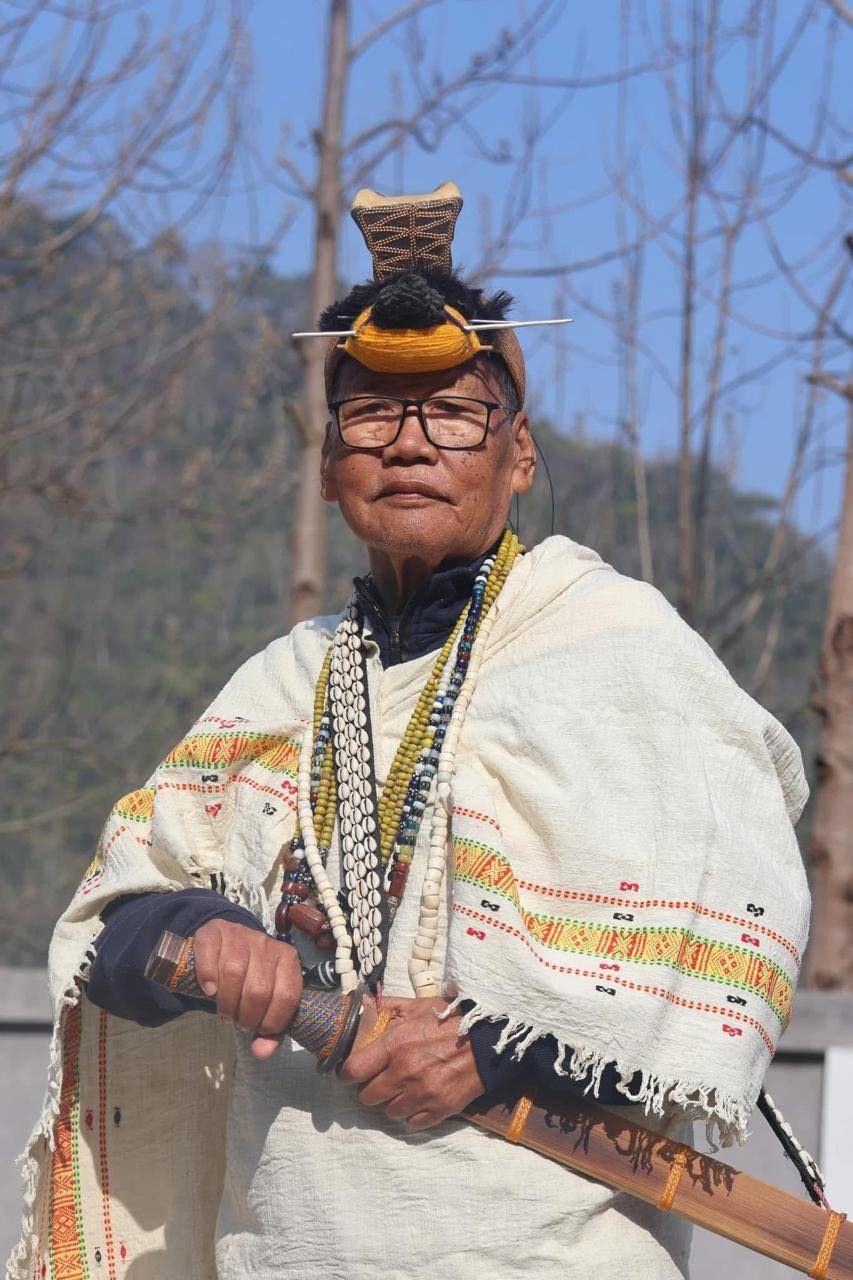
By Special Correspondent
NAHARAGUN, May 14: Dr Bengia Tolum, widely known for his social work, while some recognize him as former Nyishi Elite Society (NES) president and others as former Arunachal Indigenous Tribes Forum (AITF) president, but he never sought any position to serve society. His zeal for public service was always evident in his actions.
Back in early 1970s, when rice was most valued grain yet scarce due to climatic factors, pests, and animal attacks, he had opened the first fair price shop in Yazali, first in Keyi Panyor district. Through this initiative, rice became accessible not only to district people but also to those from the neighboring Mengio block of Papum Pare.
In 1987, he had set up the first photo studio in Yazali, enabling people to get photographs for official purposes and to preserve personal memories. Traveling to Ziro or Lakhimpur for such basic needs was extremely difficult then due to poor transportation and almost no private vehicles and only a few Govt buses and trucks operating.
During 1980s, when Yazali higher secondary school was overwhelmed with students from Keyi Panyor, Kurung Kumey and Kra Daadi, many were deprived of quality education due to limited capacity. While a few privileged families sent their children to Shillong, the majority had no access to good education nearby. Recognizing this gap, Dr Tolum envisioned providing quality education within the community.
This vision materialized with the establishment of Abotani Academy on 14.07.1993. The institution has produced numerous civil servants, police officers, doctors, engineers, teachers, administrators, politicians and social leaderssince then.
His mission was never profit-driven. Fees were minimal and in many cases waived entirely for students from economically weaker backgrounds. He firmly believed that education should be accessible to all.
He had a special compassion for orphans, providing them free education and even sheltering them in his own home when guardians were unable to pick them up during vacations.
In 1980s, due to the absence of medical stores, people struggled to access medicines. To address this, he brought a pharmacist from Assam and helped establish a pharmacy in Yazali.
Understanding that people still needed to travel to Ziro and Itanagar for many services, he started daily bus services to these towns, greatly improving connectivity. He also had set up a vehicle repair workshop (Miranda Motorworks) and tyre resoling centers (Monalisa Trade and Tyres).
Despite owning multiple establishments, his efforts were never profit-oriented. Charges were minimal, just enough to sustain operations. While he appeared prosperous from the outside, he and his wife often struggled financially.
Among all his passions, his love for tradition and culture stood foremost. In 1996, he organized a Nyishi language workshop, bearing all expenses including travel, accommodation and food. Following this, he published books on Nyishi literature, including Nyishi Kitab Akin, Nyishi Kitab Enyi and Nyishi Kitab Oum, outcome of years of dedicated research.
In 1997, he introduced Nyishi as a third language for classes V, VI, and VII and personally taught students. He also trained students in Nyishi songs and encouraged them to use the language in daily conversations within school and hostel premises.
He extended his efforts beyond his institution by collaborating with the principal of Sher VKV, where he personally taught Nyishi songs alongside students of Abotani Academy. He also contributed to YazaliNyedar Namlo by teaching devotional songs composed by him.
He deeply supported artists—both by providing platforms and financial assistance. Many artists he supported early in their careers have since achieved great success.
His compassion extended beyond his district. During 1980s and 1990s, when Kurung Kumey and Kra Daadi students faced difficulties securing admission in Yazali, he acted as their local guardian. Today, many of them are serving the state in various capacities. Without his intervention, the course of their lives might have been very different.
A proud Nyishi and a true patriot, he demonstrated remarkable courage during the Nyishi-Apatani conflict. At a time when administration and law enforcement were largely paralyzed, he coordinated with authorities and personally ensured safe escort of Apatani civilians to Hapoli, Ziro.
When a chief minister made the controversial remark that “Nyishis are only in quantity, not in quality,” Dr Tolum led a strong protest, uniting community leaders and politicians. The movement was so impactful that the CM personally visited his residence, offering him the post of EAC along with official perks. Tolum firmly rejected the offer, stating that a leader holding such views had no moral authority to govern. This stand contributed to the eventual fall of that Govt.
He also played a crucial role in opposing the proposed dam project by NEEPCO, which would have submerged Yazali town, displacing thousands. Despite being offered a position as liaison officer to withdraw his protest, he stood firm. Ultimately, NEEPCO abandoned the plan, preserving Yazali’s land, heritage and future.
In recognition of his lifelong service, Tolum was honoured multiple times by the GoAP, received several accolades, including an Honorary Doctorate in 2022 for his contribution to socio-cultural integration.
He will be remembered for his immense contributions to language, culture, education and community integration, which have left a lasting legacy in the state. In his passing, the state has lost a visionary leader and a true guardian of indigenous identity.
“With profound grief and deep respect mourned the sad demise of Dr Bengia Tolum, former Nyihi Elite society (NES) president, a towering social reformer, cultural architect, one of the most influential indigenous leaders of the state and father of joournalist Bengia Ajum here on Thursday, Chief Minister Pema Khandu wrote on X.
Tolum devoted his entire life to public service, playing a key role in strengthening Nyishi identity, promoting indigenous culture, and fostering unity among communities. As a long-serving leader of the NES and Arunachal Indigenous Tribes Forum (AITF), he was instrumental in several historic movements for social harmony, cultural preservation and inter-tribal peace.
He conveyed his deep sense ofcondolences to the bereaved family and all those who were touched by his life and legacy. “I pray Lord Buddha to grant strength to the family in this moment of grief and may the departed attain eternal peace,” Khandu added.
Expressing deep sorrow over the demise of Dr. Tolum, Deputy Chief Minister Chowna Mein, in his condolence message, termed him as a visionary leader and a committed social reformer who dedicated his life to the welfare and played a pivotal role in strengthening Nyishi identity and rights of state’s indigenous communities.
“Deeply saddened to learn about the passing of Dr. Bengia Tolum. Through his leadership, the AITF worked tirelessly for the welfare, identity and rights of indigenous communities. His immense contributions towards society and the state will always be remembered,” Mein said. ina release.
Dr. Tolum played a pivotal role in several historic initiatives aimed at promoting social harmony, cultural preservation and inter-tribal peace in the state. His contributions towards education and social upliftment, including establishment of Abotani Academy and support for underprivileged students, have left a lasting impact on state’s social and cultural landscape.
Mein conveyedhis heartfelt condolences to the bereaved family members, friends, colleagues, admirers, and the larger community. “May Lord Buddha bless the departed soul with eternal peace and grant strength and comfort to the bereaved family,” he added. (PRO)
The Arunachal Publishers & Broadcasters Guild (APBG) has expressed profound grief and sorrow over the passing of renowned social reformer, educationist, indigenous rights advocate Dr. Bengia Tolum.
In a condolence message, APBG described late Dr. Tolum as a visionary leader whose lifelong dedication to society, education, indigenous culture, and public welfare transformed countless lives across NE region, Arunachal Pradesh in particular.
APBG said that Dr. Tolum’s contributions went far beyond organizational positions and titles. Whether through establishing the first fair price shop, introducing essential public services in Yazali, promoting affordable education through Abotani Academy, supporting poor and orphaned students, preserving Nyishi language and literature, or standing firmly for indigenous rights and public causes, his life remained deeply rooted in selfless service.


 20

