
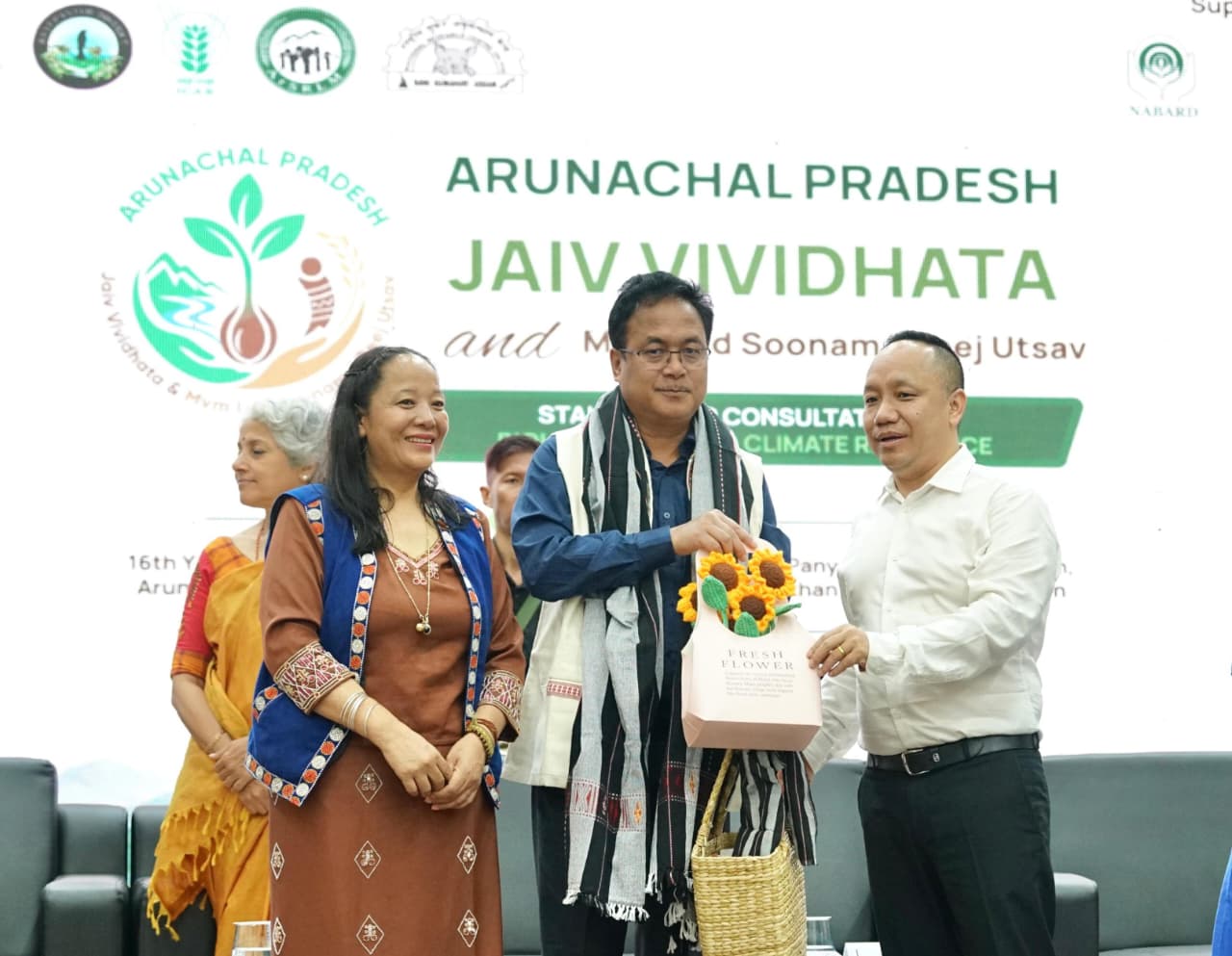
YACHULI, May 28: “Arunachal Pradesh has the potential to become a national model for sustainable and community-driven development. The world is searching for sustainable models of development, and the answers already exist in this state,” said Agriculture and Allied Minister Gabriel D. Wangsu here on Thursday.
He was addressing the inaugural function of two-day Arunachal Pradesh Jaiv Vividhata & Mvm Liid Soonam/Beej Utsav 2026 and Stakeholder Consultation on Biohappiness and Climate Resilience at GHSS in Keyi Panyor district here that focused on agrobiodiversity conservation, indigenous seed systems, climate resilience, sustainable livelihoods and traditional ecological knowledge systems.
Jointly organised by Yachuli MLA, Krishi Vigyan Kendra (KVK), Arunachal State Rural Livelihoods Mission (ArSRLM) and Chennai’s M. S. Swaminathan Research Foundation (MSSRF), the event brought together farmers, scientists, researchers, policymakers, indigenous community representatives, women seed conservers, youth groups and development practitioners from across the state.
Highlighting growing impact of climate change on agriculture, Wangsu said erratic rainfall, shorter winters and increasing floods are directly affecting farmers and rural communities. Indigenous rice varieties and traditional crops preserved by local farmers over generations are naturally adapted to local ecosystems and crucial for future food security. he emphatically said.
“Losing these traditional crops would not only be a cultural loss, but also a serious threat to our future food security and resilience,” he stated.
Calling for collective action, he emphasized that biodiversity conservation and climate resilience cannot be achieved through Govt efforts alone. Community participation is the key because no Govt alone can protect biodiversity, and no scientist alone can conserve seeds,” he said and urged villages, panchayat institutions, youth groups and farming communities to actively take part in conservation.
Welcoming growing awareness on Protection of Plant Varieties and Farmers’ Rights (PPV&FR) Act in the state, he lauded efforts to secure intellectual property rights protection for 12 indigenous paddy varieties of Lower Subansiri district.
Describing quality seeds as the “foundation of agricultural transformation,” Wangsu underlined the need to strengthen seed villages, community seed banks, local seed certification systems, cold storage infrastructure and farmer-led seed production systems across the state.
Highlighting vital role of women in preserving agrobiodiversity, he called them “true custodians of biodiversity” in tribal communities. Encouraging youth participation, he urged young people to view agriculture as a modern and innovative profession connected with sustainability, entrepreneurship, food processing, eco-tourism and digital marketing.
“Our young people should see agriculture not as a last option, but as a meaningful profession that connects livelihood with sustainability,” he said.
Reaffirming commitment of the GoAP led by Chief Minister Pema Khandu, he said that it has been closelyworking with premier institutions and stakeholders to promote climate resilience and sustainable development suited to NE’s unique ecological conditions.
A major attraction of the programme was the
Community seed conservers, especially from Nyishi and Apatani communities, showcased indigenous crop varieties, traditional farming practices and biodiversity-based livelihood models in Arunachal Seed Festival and Agrobiodiversity & Sustainable Livelihoods Exhibition.
Local MLA Toko Tatung, MSSRF chairperson Dr. Soumya Swaminathan, architect Rajeev Sethi, GuwahatiPPV&FRA’s Dr. Atul Chandra Sharma, DC Shweta Nagarkoti Mehta, MSSRF Biodiversity programme director Dr. E. D. Israel Oliver King, along with representatives of NABARD, Rajiv Gandhi University, ICAR and farmers were present. (PRO)


 20
