
Beyond the Horizon
By Pradeep Kumar
Union Environment Ministry’s Forest Advisory Committee (FAC) has granted in-principle forest clearance to 1,200 MW Kalai-II hydroelectric project, proposed on Lohit River, which is one of the key habitats of the critically endangered White-Bellied Heron in Arunachal Pradesh, a May 31 New Delhi report said.
The nod paves the way for clearing 869 hectares of forest for the project, including the submergence of 638 hectares in Anjaw and Namsai forest divisions. The THDC India Limited’s ₹14,176.26 crore run-of-the-river project is proposed in Anjaw district bordering China, and will involve construction of a 128.5 m concrete gravity dam and an underground powerhouse.
Compensatory afforestation for the project in Madhya Pradesh, as Arunachal Pradesh is a “hilly and forested State with forest cover more than two-thirds of the geographical area”, During the project’s appraisal on May 8 last, the GoAP’s nodal office informed the FAC that the heron species “is not spotted in the area proposed for diversion”.
Once spotted regularly along Namdapha’s Noa-Dihing River, this Critically Endangered species has vanished from monitored sites in recent surveys. The loss of this species would reflect a growing imbalance within the river ecosystems it depends on.
Two elusive White-Bellied Herons were spotted in Arunachal Pradeshfirst for India make, as reported on 24.09.23.
The rare and threatened white-bellied heron (Ardea insignis) was spotted close to human habitationat an elevation of 1,200 metres above sea level in Arunachal Pradesha high-altitude area for the first time in India, sparking hope for potential conservation habitats.
Marked as Critically Endangered in the International Union for Conservation of Nature (IUCN) Red List of Threatened Species because of its extremely small and rapidly declining population, the heron is listed as a Schedule 1 species in India’s Wild Life Protection Act, 1972, according it the highest legal protection.
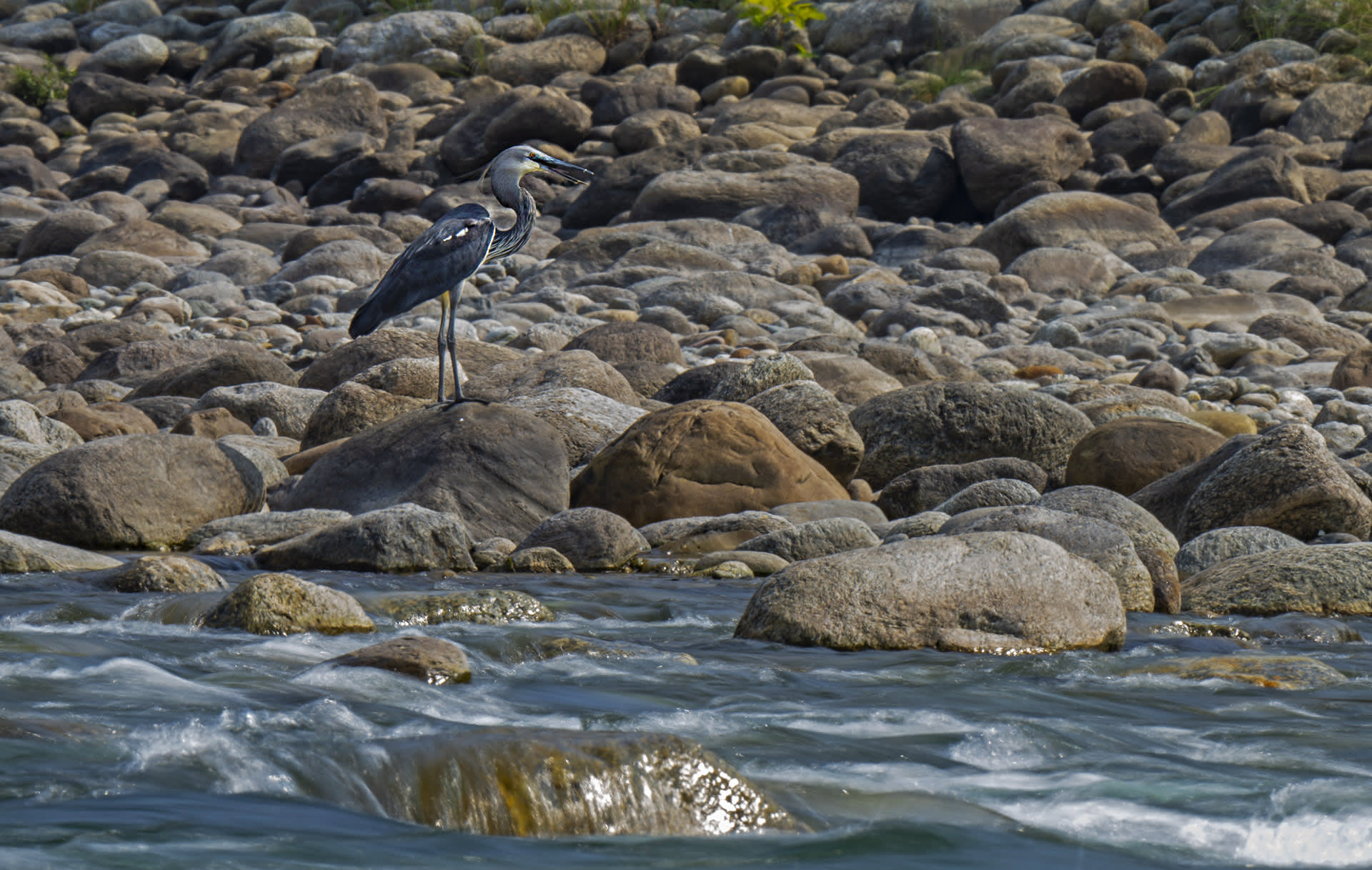
Graceful with its long neck, the large size dark grey heron has a contrasting white throat, belly and vent, lending it its name. It is mostly recorded from rivers. The IUCN notes that the species has residential populations in Bhutan and India (including in Manas National Park in Assam), and a breeding population in Myanmar. The bird is possibly extinct in Bangladesh and has been confirmed to be extinct in Nepal. The bird’s global population is thought to be around 250 out of which 50 are in NE India’.
In Arunachal Pradesh, the bird has been sighted before, at the Namdapha Tiger Reserve, and the first nesting site was recorded in 2014. Camera trap images have recorded the species in the adjacent Kamlang Tiger Reserve. Now, two individuals of the birds have been sighted,, according to forest department officials.
State environment and forest department Officials from the consisting of Anjaw Forest Division DFO Santosh Kumar Reddy, scientist Dekbin Yonggam and range forest officerNosing Pul spotted and photographed the birds at Walong in Anjaw district in April 2023.
An official statement said that the presence of nesting sites within the area is a “positive sign for the future habitats”. The bird’s breeding season starts in February and lasts till June. State PCCF R.K. Singh, said, “It is great news that this critically endangered bird is establishing new habitats beyond its traditional range. The sighting is a positive indicator of state’s forest ecosystem.”
Chief wildlife warden G. Kumar, said, “It is a good sign for the rare bird to appear in the pristine forest area. A team of scientists from the state forest department, Wildlife Institute of Indiaand Zoological Survey of India will jointly begin field research for future conservation prospects for the globally threatened bird”, an official release said.
For Reddy, who was part of the three-person team that spotted the birds, it was the first time he had seen the birds. “We had gone for a routine inspection when villagers informed us that the birds were seen near Lohit river,” Reddy said, adding the sighting was on 17.04.23. A nesting site was also seen at Walong, Reddy said, adding the sighting can boost ecotourism for the state. He and others also raised doubts over actual numbers of the birds’ global population, saying that it is most likely not as high as 250.
In India, the white-bellied heron breeds in Namdapha Tiger Reserve in Arunachal Pradesh and it occurs seasonally in several other protected areas, including Kaziranga, Dibru-Saikhowa and Manas National Parks and Pabitora Wildlife Sanctuary, the IUCN assessment notes.
New heron sighting is significant
Researcher Samiran Patgiri, who has been studying and documenting information about the species for a number of years, said it is a “great discovery.” Its population has greatly reduced over the years. “Bhutan has the highest population of around 22 individuals according to the latest data,” he said, observing that the number is a decrease from around 30 recorded in 2019.
The main threats are presumed to be widespread loss, degradation and disturbance of forest and wetlands, according to the IUCN. Patgiri said that the threats to the population are different in different places. “In Bhutan the population is threatened by the hydropower projects while in NE India the birds face threat of human interference,” said Patgiri, a doctoral candidate of Mizoram University.
This was first time a nesting site was recorded since the 2014 recording in the Namdapha Tiger Reserve, a proof of presence of the bird, saidPatgiri, also a member of IUCN’s Species Survival Commission Heron Specialist Group and has documented the bird’s presence in Manas National Park. He said that the birds have been sighted in and around reserved forest areas and a significant portion of the threat to their population is possible human interference.
The sighting was significant considering that the location is quite close to human habitations, he noted. Contrary to the figures online, Patgiri said that the global population is most likely less than 60 individuals. He said that the ‘shy’ nature of the birds could be the reason for their low numbers. So elusive is the bird that there is no local name for the bird in any of the languages of the communities that live nearby both in Arunachal Pradesh and Assam.
A 2020 paper that documented findings of a systematic, large-scale river survey in Arunachal Pradesh and Assam revealed that white-bellied heron was encountered six times in only three of 81 sites surveyed. From field observations during the river surveys as well as the interview results, the authors found that certain fishing methods, garbage and sand/gravel mining could be potential reasons for restricted occurrence of the heron in the region. Hunting is also a threat that prevails across the region, the study added.


 20

