
By Staff Correspondent
ITANAGAR, June 27: When torrential monsoon rains lashed Arunachal Pradesh, few could have anticipated the scale of destruction that would unfold. Beginning early in the morning, on June 24relentless rainfall triggered flash floods and massive landslides across Keyi Panyor and Papum Pare districts, washing away roads and isolating hundreds of residents. Within hours, normal life came to a standstill as the region’s communication network collapsed under the fury of nature.
For hundreds of commuters stranded on either side of the damaged roads, and for rescue operators dependent on road connectivity, the situation quickly evolved into a severe crisis. Essential commodities could no longer move, emergency services struggled to reach affected areas, and access to critical healthcare became restricted.
Yet, during this period of isolation, the long-standing partnership between Arunachal Pradesh people and Border Roads Organisation (BRO) was once again visible on the ground. Treating the crisis not merely as an engineering task but as a vital duty to the community, BRO’s Project Arunank responded without delay to restore the state’s severed connections.
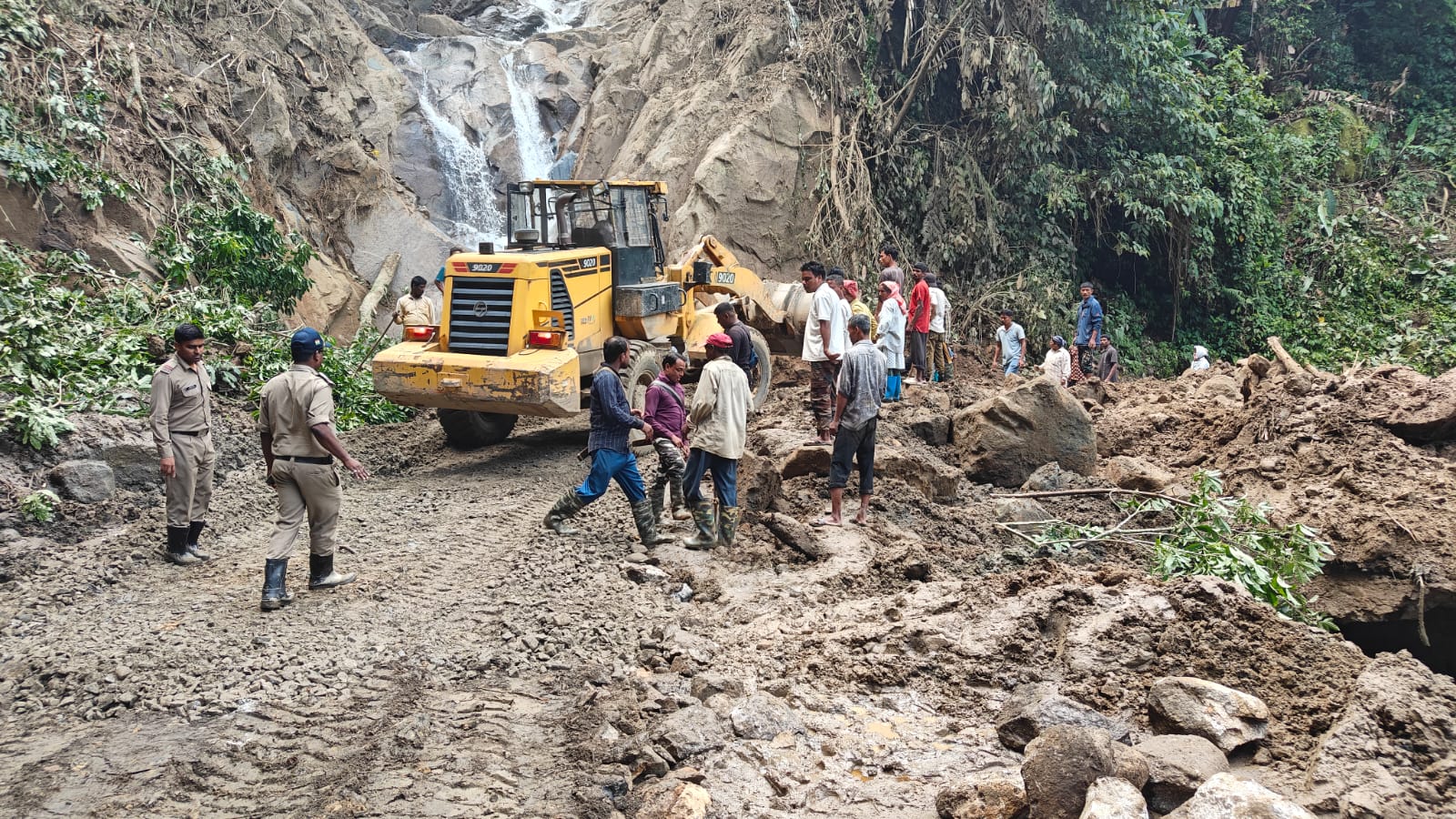
The flash floods inflicted widespread damage along the Kimin–Potin Road, a critical alternate route connecting Keyi Panyor and Papumpare districts of Arunachal Pradesh. Massive landslides buried this artery under mud, boulders, and uprooted trees across a 45-kilometre stretch.
The most severe destruction occurred at 42-km and 44-km, where powerful floodwaters caused major formation breaches, washing away substantial portions of the roadway and rendering the route completely impassable. Unlike ordinary landslides that require simple debris clearance, these formation breaches demanded the complete reconstruction of the damaged embankments before traffic could safely resume.
The impact of this destruction extended beyond damaged infrastructure: The only road link to Potin, Neepco, Yazali, Yachuli, Joram, and Ziro was cut off, leaving hundreds of commuters stranded. The movement of food, fuel, medicines, and essential commodities came to a sudden halt. Ambulances and National Disaster Response Force (NDRF) teams faced immense difficulty accessing flood-hit areas.
Access to critical medical institutions, including Tomo Riba Institute of Health and Medical Sciences (TRIHMS) in Naharlagun, was temporarily compromised.
With NH-13 also closed due to extensive flood damage, the region faced the grim prospect of prolonged isolation, making restoration of Kimin–Potin road paramount.
Recognising gravity of the situation, the civil administration approached the BRO for assistance and 756 border road task force (BRTF) based at Ziro, mobilised its resources immediately, deploying all earth moving equipment and nearly 80 personnel.
The subsequent operation was carried out under hazardous conditions. Rain continued to pour almost incessantly, leaving the saturated hill slopes highly unstable. Fresh mudslides threatened the workforce, massive boulders loosened from the hillsides, and flowing water repeatedly undermined freshly repaired sections. Heavy machinery had to operate on narrow mountain roads with minimal room for manoeuvre, while engineers and operators worked under the constant risk of secondary slides.
Despite these dangers, BRO personnel continued operations around the clock. There were no pauses for daylight and no reductions in effort despite the worsening weather. Every hour mattered, as every hour of delay meant another hour of isolation for the interior communities.
The restoration effort continued through the night, with equipment operators clearing debris and engineers supervising the rebuilding of the washed-out embankments. The BRO successfully reopened Kimin–Potin road for vehicular traffic at midnight after less than 36 hours of uninterrupted operations.
The breakthrough allowed stranded commuters and relief agencies to regain access to affected areas; and the civil administration to resume emergency operations. Furthermore, the reopening of this road ensured that access to vital healthcare services was restored for residents requiring emergency medical treatment.
BRO is already working to widen this critical Kimin-Potin road to double lane specifications. It is anticipated that disruption in this road will be minimised once the widening work is completed.
Infrastructure in the Himalayan region cannot be measured merely in kilometres of road constructed; every route represents economic stability, healthcare access, and the primary connection between remote communities and the rest of the nation. While the BRO is widely known for constructing strategic roads and tunnels, its role as a reliable asset in times of crisis reflects a deeper commitment to public service.
The successful restoration of Kimin–Potin road serves as a quiet reminder that resilience is built not only through infrastructure, but through a shared commitment to stand by the people when it is needed most.


 20
