
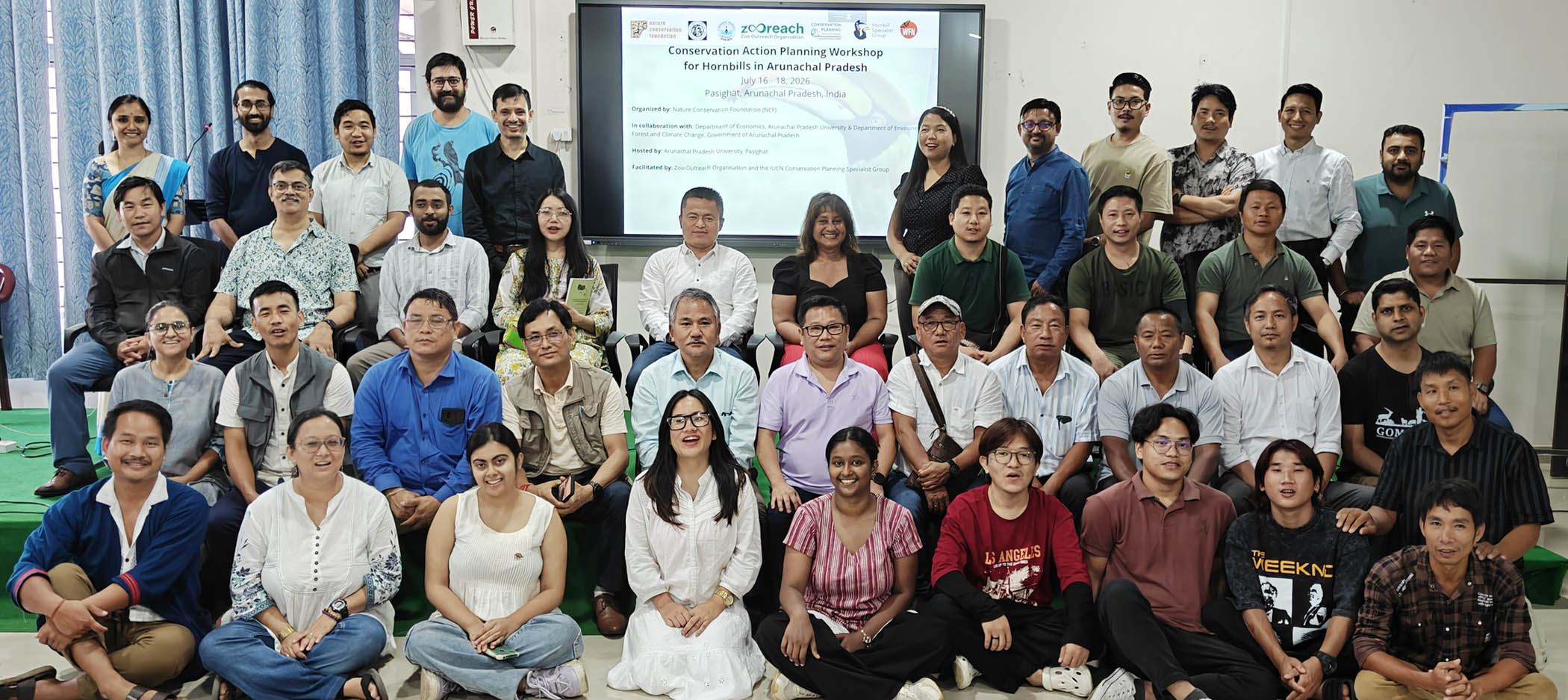
PASIGHAT, July 24:In a significant step towards safeguarding one of India’s most iconic group of birds, over 55 representatives from Govt agencies, indigenous communities, research institutions, universities, conservation organizations and civil society have jointly developed a vision and workplan of a State-wide Hornbill Conservation Action Plan for Arunachal Pradesh.
The initiative sets the ambitious goal of making Arunachal Pradesh a thriving “Land for Hornbills by 2047”, reinforcing the state’s commitment to conserving its unique natural and cultural heritage.
The state is home to five of India’s nine hornbill species—the Great Hornbill, Wreathed Hornbill, Rufous-necked Hornbill, Austen’s Brown Hornbill and Oriental Pied Hornbill. Three of these species are globally threatened, while all five are provided the highest level of legal protection under India’s Wildlife (Protection) Act. Hornbills, particularly the Great hornbill which is the state bird, holds a deep cultural significance for many indigenous communities of Arunachal Pradesh, and are known as ‘farmers of the forest’ for their critical role in dispersing seeds and regenerating forests.
Despite nearly 80% of state’s geographical area under forest cover, many hornbill populations outside protected areas face increasing threats from habitat degradation, fragmentation and hunting. Recognizing the need for landscape-scale conservation, the participants agreed on the importance of supporting Indigenous communities to protect their forests, strengthening habitat connectivity, integrating traditional ecological knowledge with scientific research, and fostering long-term partnerships across the state and adjoining transboundary landscapes.
The three-day workshop (July16–18 at Arunachal Pradesh University) was organized by Nature Conservation Foundation (NCF) in collaboration with APU’s Economics department, state’s Environment, Forests and Climate Change department and Zoo Outreach Organization.
Around 55 participants representing Forest Department, Arunachal Pradesh State Biodiversity Board, community-based organizations, indigenous leaders, researchers and scientists from RGU, Indian Institute of Science and APU,Ashoka Trust for Environment and Education (ATREE), Wildlife Trust of India (WTI), Arunachal Pradesh Community-led Conservation Forum initiated by WWF, alumni of Green Hub and representatives of Nagaland Forest Department and Nagaland Community-Conserved Areas (CCA) Forum and Aaranyak from Assam collaborated to develop a shared vision and draft action plan. The workshop is supported by the Whitley Fund for Nature, the IUCN SSC Hornbill Specialist Group, and the IUCN SSC Conservation Planning Specialist Group.
On the first day, the NCF team provided the foundation for the workshop based on their long-term work on hornbills in Arunachal, followed by perspectives and observations from many forest officials, researchers and community members. Over the next 2 days, through working group discussions, a shared vision and a preliminary action framework was developed. A smaller drafting group will now refine the document, with the first draft expected by September and the final Conservation Action Plan scheduled for completion early next year, providing a roadmap for coordinated conservation action across Arunachal Pradesh.
“This collaborative Conservation Action Plan would strengthen community-led conservation for hornbills ensuring that we can all come together to fulfil the vision for Arunachal as a land for hornbills,” said Nature Conservation FoundationExecutive Director&, IUCN SSC Hornbill Specialist Group Co-Chair senior scientist Dr. Aparajita Datta.


 20

