
NAMSAI, Aug 20: Deputy Chief Minister Chowna Mein, in his inaugural address to National Space Day 2026 here on Thursday, said that India’s space programme has evolved from an endeavour focused primarily on exploration into a powerful tool for nation-building and improving the lives of citizens.
Satellite-based technologies, remote sensing, GIS and other space applications are increasingly contributing to disaster management, agriculture, natural resource mapping, infrastructure planning, environmental monitoring and governance, he said.
The event, jointly organised by Arunachal Pradesh Space Application Centre (APSAC) and the North Eastern Space Applications Centre (NESAC), brought together students, scientists, officials and dignitaries to celebrate India’s remarkable progress in space science & technology by highlighting growing relevance of space applications in the development of NE, Arunachal Pradesh in particular.
Emphasizing on the significance of space technology and its importance particularly for this state, he asserted that greater use of space-based technologies can strengthen planning, improve disaster preparedness, support sustainable management of natural resources and enable more efficient delivery of development initiatives.
Appreciating the students, Mein said, “Such exposure gives young people an opportunity to understand the practical applications of space science while encouraging curiosity, scientific thinking and innovation,”.
He also encouraged them that National Space Day provides an important platform for connecting young minds with India’s achievements in space science.
Continued engagement with institutions such as ISRO, APSAC and NESAC would help inspire more students of the state to pursue education and careers in science, technology, engineering and related fields, he said.
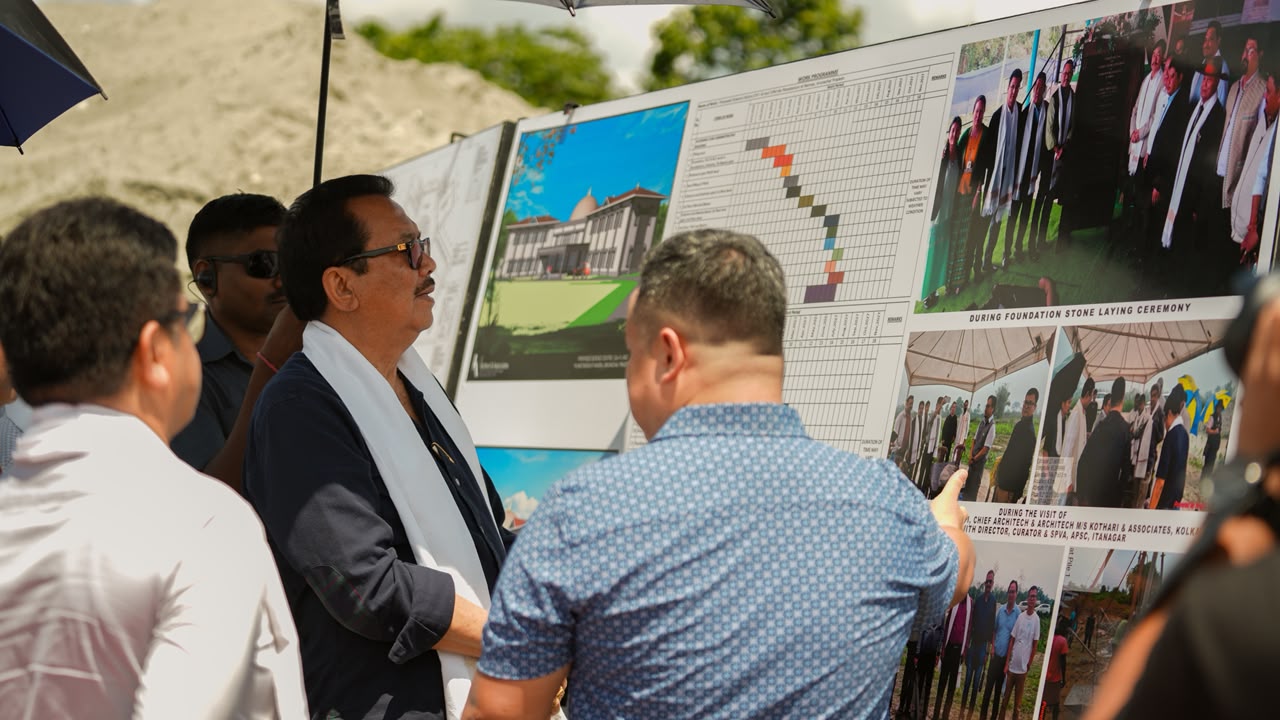
Later, he also inspected the site for the upcoming state-of-the-art science centre (category-II) and 10-metre dome digital planetarium (category-II).
These facilities are developed under the Scheme for Promotion of Culture of Science (SPoCS) of Union Ministry of Culture and implemented by the National Council of Science Museums (NCSM), Union Ministry of Culture.
During site inspection, Mein reviewed the progress of the construction work and directed the executing agency to maintain the required standards of quality and expedite the work. He urged the PWD to make every effort to complete the building ahead of the scheduled completion date of March 2028, so that the facilities could be made operational for students and the public at the earliest.
Stating the Science Centre and Planetarium would be an important addition to the educational and scientific infrastructure of the State, he affirmed that the facility would provide students and citizens with opportunities to engage with science, astronomy and space exploration through interactive learning and modern technological platforms.
Mein went on to assert that the GoAP is committed to creating modern learning spaces and expanding opportunities for young people beyond conventional classrooms.
He further said that the state has immense potential to benefit from advancements in space technology and that the state must continue to strengthen collaboration with national institutions and make greater use of technology for inclusive and sustainable development.
Stressing on the state’s progress towards Viksit Arunachal Pradesh that would be strengthened by investing in education, science, technology and innovation, he said it would contribute to larger national vision of Viksit Bharat 2047. (PRO)


 20
