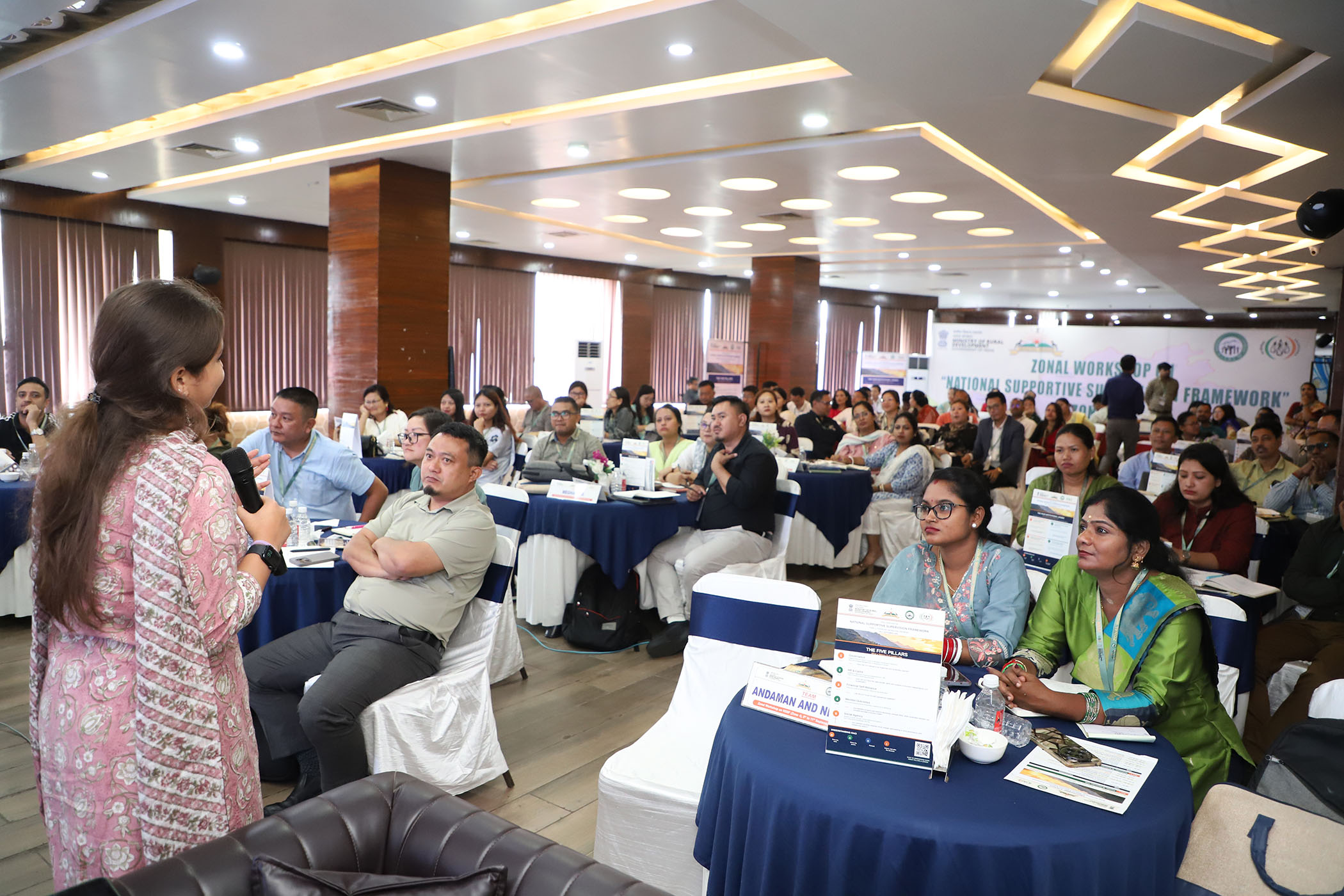
ITANAGAR, Sept 8: A four-day zonal workshop on the national supportive supervision framework (NSSF) began in Itanagar on Tuesday, bringing together officials from eight northeastern states and the Union Territory of Andaman and Nicobar Islands to work on strengthening Community Level Federations (CLFs) under the rural livelihoods programme.
The workshop, being held from September 8 to 11 at Donyi Polo International Hotel, is hosted by the Arunachal State Rural Livelihoods Mission (ArSRLM) under the Deendayal Antyodaya Yojana-National Rural Livelihoods Mission (DAY-NRLM).
The programme focuses on improving the institutional capacity, governance and financial sustainability of CLFs, with an emphasis on helping them evolve into self-reliant, women-led and community-owned institutions.
In her opening remarks, ArSRLM CEO-cum-SMD Sangeeta Yirang welcomed representatives of the participating states and the Union Territory, National Resource Persons, National Mission Management Unit (NMMU) representatives and other participants. She described the workshop as an opportunity for collective learning, experience-sharing and strengthening implementation of the NSSF.
Representatives from Assam, Manipur, Meghalaya, Mizoram, Nagaland, Sikkim, Tripura and Andaman and Nicobar Islands are participating in the workshop along with officials from Arunachal Pradesh.
The NSSF seeks to move the focus of supervision from conventional compliance-based monitoring to a more supportive and institution-focused approach. It is designed to help CLFs strengthen ownership, autonomy and long-term sustainability.
The framework is based on five key pillars — governance, human resources and cadre, financial self-reliance, member outcomes and social agency. It also uses four institutional lenses to assess CLFs as social entities, self-reliant organisations, horizontally coordinated institutions and open systems linked to their wider social and economic environment.
On the first day, participating teams are presenting field observations and analysing them through the NSSF lenses to identify institutional gaps and areas requiring support.
The second day will focus on group presentations, validation of observations and preparation of action plans, including plans for Swavalambi CLFs. The third day will be devoted to finalising state-wise action plans with the support of National Resource Persons and NMMU State Anchors.
The workshop will conclude on September 11 with presentations of state-level action plans and a way-forward session. The plans will cover Swavalambi, Model CLF (MCLF) and General CLF interventions.
A major focus of the workshop is enabling CLFs to achieve greater operational and financial self-reliance while improving governance and economic outcomes for their members. The framework also encourages stronger linkages among Village Organisations, Self-Help Groups, Producer Groups, Farmer Producer Organisations, government departments, markets and other local institutions.
The workshop is expected to help participating states develop practical, state-specific strategies for strengthening community institutions and translating the principles of supportive supervision into concrete action.
The Itanagar workshop is being seen as an important platform for promoting stronger, more autonomous and financially sustainable women-led community institutions under DAY-NRLM.


 20