
By Special Correspondent
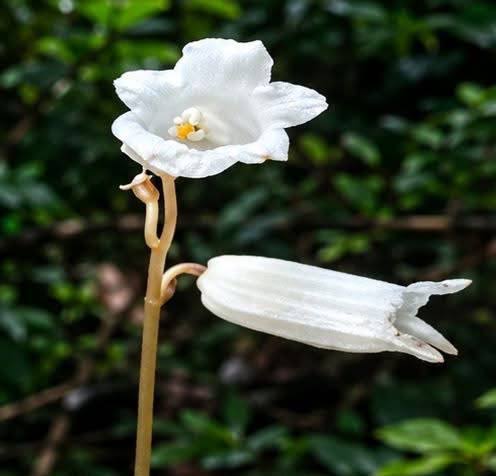
ITANAGAR, Sept 20: Researchers have discovered a rare leafless orchid species, scientifically known as Gastrodia keyiensis, in Keyi Panyor district of Arunachal Pradesh, adding to the region’s rich biodiversity.
This elusive orchid,which grows indeep shade and on decayig litter, is a holoycotrophic speies that relies on soil fungi for nutrients.
It is a member of Gastrodia genus, which typicaally grow upto 35 cm tall and features one to three white to pale bluish flowers with a distrinctive yellow, strongly curved lbellum.
The species was found during a botanical survey in a remote gorge along the Keyi River at an elevation of around 1,000 metres. Only five flowering individuals were recorded at the site. The orchid lacks leaves and chlorophyll and depends on soil fungi for nutrients.
Locally called “Oram Opuh”, meaning “Ghost Flower” in Nyishi dialect, highlighting its elusive nature. Researchers have classified it as data deficient (DD) because of its limited known distribution, short flowering period and largely underground life cycle.
The discovery has been published in the international journal Phytotaxa, authored by a team of researchers from various institutions. Thediscovery of this rare orchid underscores the importance of preseving the unique biodiveristy of the Eastern Himalayas.
Rich biodiversity makes Arunachal Pradesh one of the 12 biodiveristy hot spots of the world .Of total 30,000 accepted orchid species found in the world, 600 orchid species have been docuemented in the state making it “Orchid Paradise of India”.
State’s orchid flora incldues rare and endemic species,like Cypripedioideae or commonly known as lady’s slipper, which are integral to the region’s bodiveristy and ecosystem services.
The lady’s slipper is characterised by the slipper-shaped pouches (modified labella) of the flowers – the pouch traps insects so they are forced to climb up past the stainode, behind which they collect or deposit pollinia, thus fertilizing the flower.
There are approximately 165 species in the subfamily. The species in this subfamily form trap flowers in which insect access to the saclike lip from the front is quite easy. The inside is shaped in such a way that the insects climb out of the flower past the stigma and the stamens and thereby pollinate the flower.


 20
