
By Pradeep Kumar
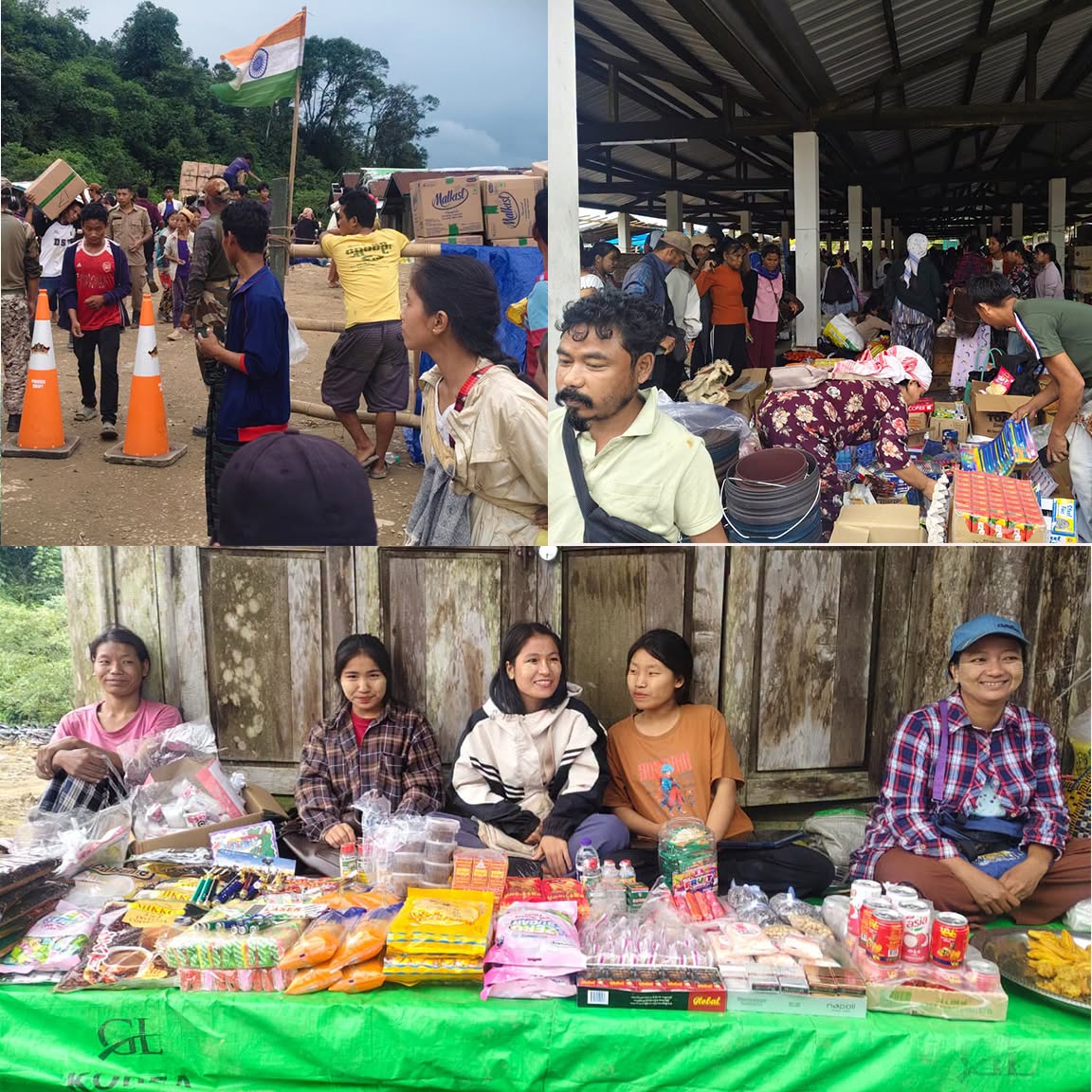
ITANAGAR, Sept 22: The Border Haat at Pangsau Pass in Changlang district opened at Jairampur on September 20 under its revised monthly schedule as facilitated by the Assam Rifles (AR).
The market saw participation from 143 vendors, 96 from India and 47 from Myanmar, besides hundreds of visitors from both sides of the international border. Overall participation crossed 900, including traders, farmers, residents and vendor helpers, AR sources told this daily.
Operating from 8 am to 6 pm, the Border Haat served as a platform for local trade and interaction between communities living along India-Myanmar border. Final sales figures are awaited from the SDO office.
Pangsau Pass is 12-km from Nampong, lies on the crest of the Patkai Hills on India-Myanmar border on the famous Ledo Road (Stillwell Road), named after the closest village on Myanmar’s territory, Pangsau, lying 2-km east of the Chaukan pass, east of Vijaynagar in Changlang district, lies northeast of Pangsau Pass.
Pangsau Pass Border Haat reopened after six years
Pangsau Pass is a strategically important border point that marks the boundary between India and Myanmar. The historic Pangsau Pass Border Haat at Nampong had resumed operations on 20.07.26 after a gap of six years, strengthening India-Myanmar relations and cross-border trade. The market will now operate three days every month on 10th, 20th and 30th.
“Delighted to share that the Market at Pangsau Pass Border Haats in Nampong resumed after a gap six years on 20.07.26. The market will be opened three days in a month (10th, 20th & 30th), which will significantly boost border tourism, strengthen trade relations between the two countries and benefit the local people. Everyone is welcomed,” Nampong MLA Laisam Simai wrote on his Facebook.
Indian citizens can cross the border to visit the market on designated “India days” with the required protected area permit (PAP) or other local permissions. On Fridays, known as “Burma Day,” Myanmarese villagers cross into Nampong to shop on the Indian side.
Trade has remained suspended for the past six years due to the Covid-19 pandemic. Following a meeting, an order was issued the same day notifying the resumption of the Border Haat from July 10, along with a standard operating procedure (SOP) to regulate its functioning in a “systematic, transparent and secure manner.”
Cross-border commerce under the Free Movement Regime (FMR) allows residents living within a 10-km radius on either side of the India-Myanmar border to engage in local commerce and cross-border exchanges.
The reopening of the Pangsau Pass market is also expected to revive tourism in the region, as the area is home to the historic Lake of No Return, a renowned World War II site located about 12-km inside Myanmar.
China transported goods to Guwahati via Stilwell Road
On 30.12.2015, a Chinese truck for the first time since 1962 had used the Stilwell Road to bring goods to India. The Chinese truck had crossed Nampong at Pangsau Pass, taking the road from Baoshan in China’s Yunnan Province, with organic tea, coffee, toys and electronic goods kept in 82 packets, meant for the Chinese participants of the 3rd Assam International Agri-Horti Show 2016 in Guwahati, according to then Arunachal Pradesh trade and commerce director Tokong Pertin, who said it came as “a ray of hope for a better future for business in the state.”
“Even though the customs office in Nampong was notified in 1950, the trade route was non-operational for about 70 years. There is now hardly any record available on trade done through the route. After the 1962 Chinese aggression, all hope of reopening the office ended. But on 30.12.15, it was reopened to let in the goods brought by that truck from China,” Pertin said.
“Though the GoAP was not directly involved, the district administration was informed about it and I was there only to witness the historic moment,” Pertin had said, adding these developments were result of a January 2014 meeting in New Delhi by the UPA Govt to boost border trade with Myanmar.
It may be recalled that the British in late 19th century considered the pass as a possible railway route from India to Myitkyina in north Burma through the Hukawng Valley, all of which were part of the British Empire then, but no railway was built. In 19th century, British railway builders had surveyed the Pangsau Pass, which is 3,727 feet high on the India-Burma border, on the Patkai crest, above Nampong in Arunachal Pradesh, Ledo and Tinsukia (part of Assam).
They found that a track could be pushed through to Burma and down the Hukawng Valley. Though the proposal was dropped, the British prospected the Patkai Range for a road from Assam into northern Burma. British engineers had surveyed the route for a road for first 130-km.
Interestingly, during World War-II the pass became famous because of the Stilwell Road (Ledo Road) connecting British India to Nationalist Chinese forces fighting the Japanese in China. The pass was the large initial obstacle encountered by United States General Joseph “Vinegar Joe” Stilwell’s forces in their effort to build a land route to supplement The Hump air route (after the other land route, Burma Road was lost to advancing Japanese forces).
The Stilwell Road begins at Ledo, the railhead, and passed through Tirap, Lekhapani, Tipong, Jagun, Jairampur (Assam-Arunachal Pradesh boundary and beginning of Inner Line), and Nampong before switch-backing steeply upwards through densely forested hills to the pass, 12-km away. The distance from Ledo to Pangsau Pass is 61 km. Because of the fierce gradients and the mud, which made getting up to the pass difficult, it was nicknamed “Hell Pass” during the war.
The three-day Pangsau Pass Winter Festival since 2007 is a joint India-Myanmar annual global event organized during 3rd week of January annually in Nampong. It showcases diverse cultures of NE India and Myanmar including folk songs, folk dances, arts, crafts, ethnic foods, traditional sports, and culture of Tangsa tribe, Tangsa Rongrand War dance, Lungchang dance, Wancho dance, Bihu dance and Bamboo dance.


 20

