
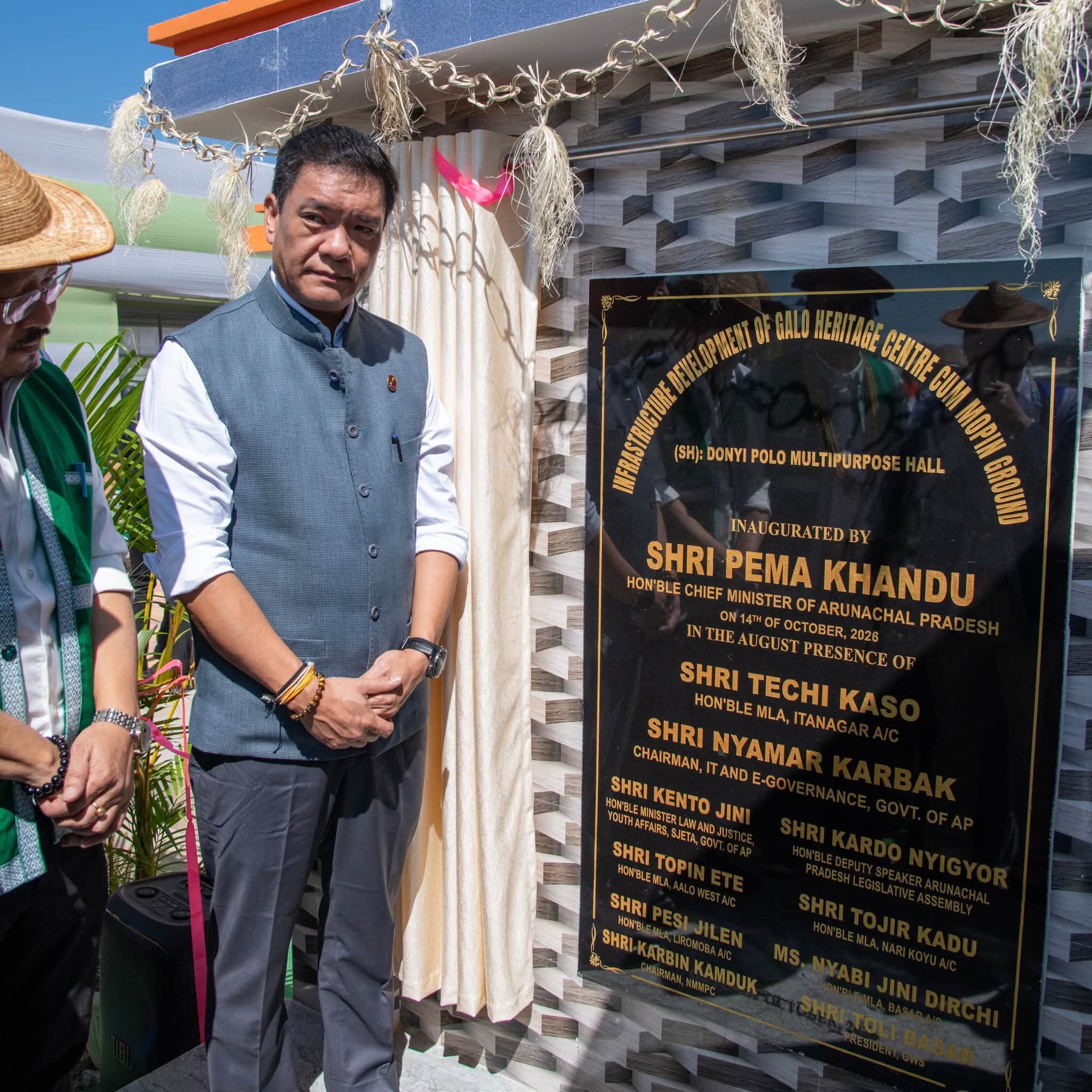
NAHARLAGUN, Oct 14: Chief Minister Pema Khandu after inaugurating Donyi Polo Multipurpose Hall at Galo Heritage Centre (GHC) at Tarajuli, near here on Wednesday, termed it as a landmark of community participation and cultural resolve.
The programme was organized by Naharlagun Mopin Management and Promotion Committee, caretaker of theGHC, in coordination with Galo Welfare Society and clan-based organizations.
“The project was far more than a Govt-funded building. The Mopin ground at Naharlagun, in use since 1976, was handed over voluntarily by Galo community to make way for state’s first medical college, Tomo Riba Institute of Health and Medical Sciences (TRIHMS),” he said.
The community then formed a committee, identified a new site and purchased about 11,217 square metres of land with its own contributions. Clan organizations built the boundary walls and traditional gates and more than 430 individuals donated funds, he said.
The hall, sanctioned under the Centre’s Special Assistance to States for Capital Investment after the CM’s 2022 assurance, was completed in about a year, against two to three years such projects usually take. Khandu credited community ownership and team effort, and said the Galo example would inspire other tribes across the State.
He said the hall, named for Donyi Polo, the faith of the Sun and the Moon, will serve as the permanent venue for Mopin and as a living centre where youth learn songs, dances and crafts and elders pass on their knowledge.
The CM announced that the drainage system required at the GHC premises will be approved within this year, and that a shed will be built at Itanagar Mopin and Solung ground for use by both the Galo and Adi communities. The urged for a Galo Secretariat and Heritage Infrastructure.
Responding to a memorandum, he said larger road projects would take time. He reiterated that the Centre’s support for a two-lane road between Ruksin and Kimin is conditional on land being donated free of cost along the surveyed alignment and he would proceed once communities provide written consent.
On Assam-Arunachal boundary, he said disputes over 123 villages have been largely resolved under the Prime Minister’s leadership and 31 of 32 contested areas in Papum Pare district were settled in recent joint on-ground visits by regional committees. He said work on other long-pending issues, including the Chakma question, is advancing and that the people will be informed at the appropriate time.
Urging society to value all work equally, he said countries that have developed, place high dignity on labour, and encouraged to build a similar work culture. He called for local youth to be trained in construction, electrical and plumbing trades, so that the state depends less on outside skilled workers. He cited a batch of 50 youth sent to the National Skill Centre in Hyderabad, who later executed a project in Pasighat for ₹10 lakh against a ₹18 lakh quotation from an outside team.
Stressing that Govt jobs cannot absorb everyone, he encouraged entrepreneurship, including through the MSME sector and Arunachal Pradesh Entrepreneurship Development Program, whose capacity has been doubled with 100 entrepreneurs in its latest cohort. Under the Arunachal Academic Excellence initiative, the State bears the scholarship cost for students admitted to universities ranked within the QS top 150.
Warning that state’s tribal population are small in the national context, he said identity is at risk if language and tradition are lost. While the government can only support through policy, he said, communities themselves must preserve their heritage and pass it on. Referring to artificial intelligence and machine learning, he urged people to use technology as a servant rather than become subservient to it, and to prepare for its impact on jobs without losing age-old culture.
Highlighting state’s decade of governance, Khandu noted that more than 1.5 lakh women are organized in over 16,000 self-help groups and that nearly 46% of startups are women-led. Over ₹3,000 crore has been invested under Mission Shikshit Arunachal Phase I, with anothers ₹1,500 crore approved for Phase II, and Govt school enrolment has risen by over 13%. The Vibrant Villages Programme covers 455 border villages in Phase I and 122 more in Phase II.
He said these efforts follow the principle of Vikas, Sewa and Virasat, citing support for indigenous Gurukul schools, 20 GI-tagged Arunachal products and steps to strengthen legal protection of indigenous faiths, as well as high-powered committees on APST safeguards, the ILP framework and illegal infiltration, to be addressed through dialogue and consensus.
Inviting every community to reflect on the road to 2047 as the state would complete 40 years of statehood on 20.02.27, he urged young people to remain proud of their roots while staying confident in a fast-changing world. (CMO)


 20
