- Make more stamps on Arunachal’s unique heritage: Kumar
By A O News Service
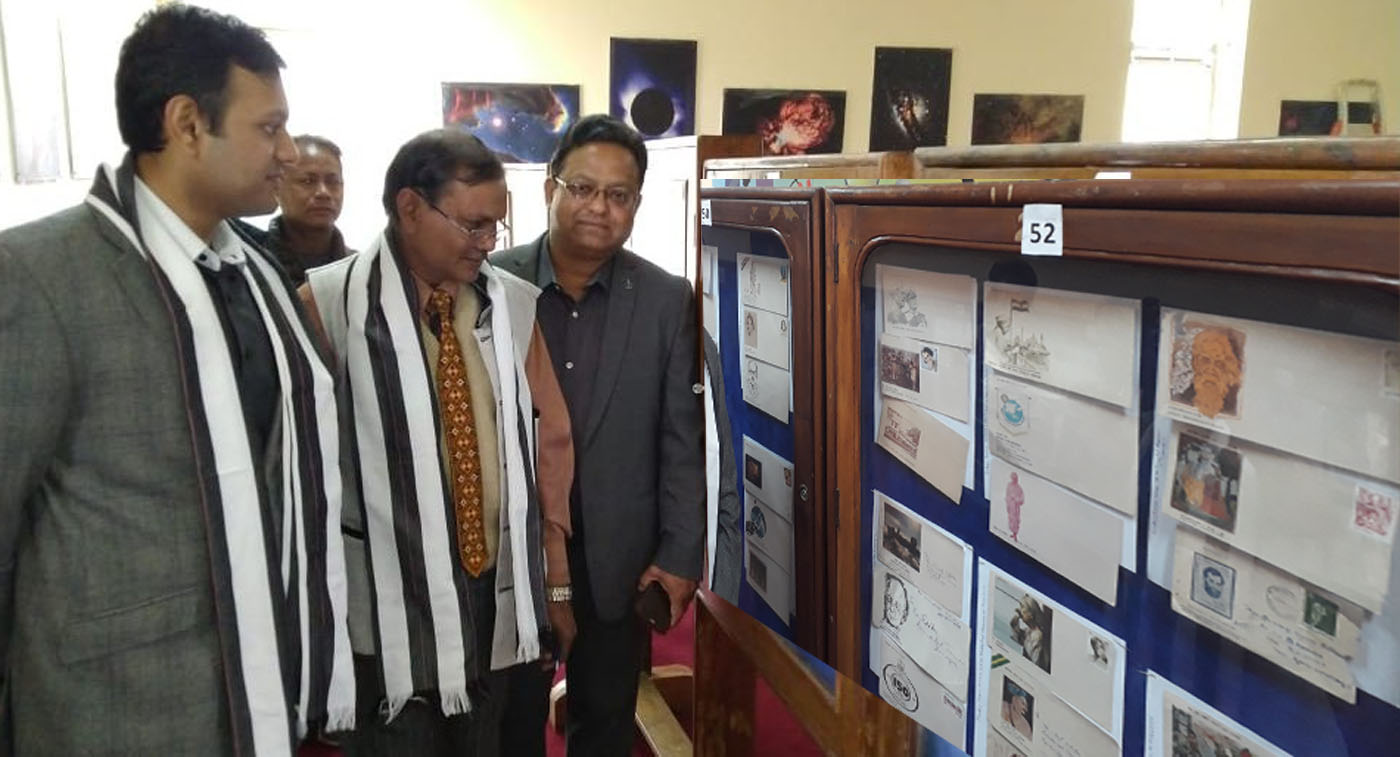
ITANAGAR, Jan 29: Philately or stamp collection is known as king of hobbies as stamps are known as paper ambassadors, Arunachal division postal services director Ashoke Pal said on Tuesday.
Addressing inaugural session of district level Arunachal Philately Exhibition at Science Centre in Indira Gandhi Park here, he said that stamps which record history, culture and traditions of a nation widen the knowledge horizon, particularly of stamp collectors. He exhorted participating hundreds of students of 13 schools of Capital Complex to adopt stamp collection as hobby to reap its numerous benefits.
He lauded senior journalist Pradeep Kumar who worked as extra department post master for about five years and an enthusiastic stamp collector to be present as guest of honour. Later, Pal told media persons that more such exhibitions would be conducted in different parts of the state and attempts made to print stamps on Arunachal.
Terming philately as science and arts, Kumar, in his address, said that an in-depth research is conducted to choose subject of any stamp making it arts while its design reflecting the essence make it science.
Highlighting history of India’s postal service, he said it has been recording rich culture, history encompassing all aspects of this sub-continent nation since its inception in 1837. However, the foundation of present Itanagar head post office worth Rs 1.63 crore was laid on 02.02.10 by then Union MoS (Communications & IT) Sachin Pilot in presence of then MP Takam Sanjoy and PWD & UD Minister Nabam Tuki. However, postal services was extend to this state since NEFA days as there was a post office at Damin in 1965, he disclosed.
Postal service, known as ‘Hill Dak’ as postman used to take even a month to reach very far-flung areas without road connectivity, has undergone sea changes from ‘Hill Dak’ to IT age but still it continues to offer invaluable services to the state, he said citing the example of huge packages seen in Naharlagun post office in April 2017 which were study materials of IGNOU.
Pointing out that there are few postal stamps on Arunachal Pradesh, including commutative multi-coloured stamp – Arunachal Pradesh-women-in-Traditional-Costumes and on rare bird Hornbill, he urged the postal department to make stamps on Donyi-Polism founder Golgi Bote Talom Rukbo as a homage to the great social reformer or India’s living heritage 15-feet tall Lord Jawa (other name of Lord Buddha) of more than 700-year-old Tserteng Gompa, located in Lumpo village at 10,000 feet above sea level very close to Sino-India border in Tawang district. The statute’s chin bore mark of bullet shot by People Liberation Army soldiers during 1962 Chinese aggression. He also suggested Dong in Anjaw district which witnesses India’s first sun rise.
Informing that French word philately was coined by Geroge Herpin in 1864, Capital Complex DC Prince Dhawan as chief guest said, adding philately, a combination of phil (o) (means an attraction or affinity for something) and ateleia (means exempt from duties and taxes). Postal charges used to be paid by the recipient of a letter before introduction of stamps but became free of charge since introduction of postage stamps, he informed.
Philately gained acceptance during the 1860s as it helps collectors to gain wide knowledge on various aspects, he said citing the demonstration of Kumar from his collection. He lauded postal department the only one to reach most interior and remote places to offer services to the people.
Appreciating letter writing and stamp design competitions as part of the event, he exhorted the students to be serious in letter writing, a though uncommon now-a-day, but improves writing skill being an art. He advised them to dream about their future career quoting former President A P J Abdul Kalam, who had said: ‘Dream is not that which you see while sleeping it is something that does not let you sleep.’
A souvenir was released by the guests to mark the occasion followed by a seminar on philately. Postal superintendent K Kharshandi earlier highlighted the objective of the exhibition.
Britishers set up Indian post office in 1837
Beyond the Horizon
By Pradeep Kumar
Indian post office was set up in 1837 by British East India Company (EIC), but it was expanded faster after India achieved independence in 1947. Composite North East Postal Circle was bifurcated into Assam & NE circles on 28.6.88 with its HQs at Shillong under administrative control of Chief Postmaster General, it covers Arunachal Pradesh, Manipur, Meghalaya, Mizoram, Nagaland and Tripura with seven postal divisions and one postal civil wing division besides two functional units – postal stores depot at Silchar and returned letter office at Shillong. Arunachal Pradesh Postal Division was set up in early 70’s with one head PO at Itanagar and 48 departmental sub-POs spread across the state and 250 branch POs, primarily located in rural areas to cover this hilly state. The postal division at Itanagar is headed by the Director Postal Services (DPS) located.
Postal services, from ‘Dak runner’ of NEFA days to present day ‘Cycle runner’, have undergone numerous revolutionary process while carving a niche for itself in the hearts of the masses. Postal services have continued to maintain its demanding roles despite present time gaining ‘IT Age’ sobriquet due to multi-faceted development.
I was reminded of ‘Dak runner’ when offices in far-flung inaccessible areas used to wait for days for the dak runner to bring mail. The waiting time was uncertain as his journey depended upon weather. Moreover, his mail collection from an air-fed station used to be subject to arrival of Dakota or AN-32 later, depending upon weather condition and clearance by air traffic control. Noted author Y D Thongchi had once elucidated about it citing examples of his past experiences. Thongchi, Sahitya Academy awardee and second longest serving DC/collector of India after Ajit Jogi, had contributed a column – ‘Hill Dak’ – for a long time in an English daily edited by me.
Moreover, in “Reminiscence of my school life at Mariyang (1970-1975), border affairs director Dr N Lego, once wrote: “Once Otokung Ratan, dak runner of Mariyang, was observing taboo by offering sacrifice for a boil on his leg. He could not attend to his duties and paid me Rs 30 only in advance to carry the daks from Mariyang PO to Pasighat PO and collect return daks. I was quite happy for that big amount and proceeded to Pasighat. I was even happier when the boatmen at Raneghat did not take fare for ferrying me over Siang River as I was on dak duty. I handed over the daks to the post master, collected return daks and returned to Mariyang”. NEFA days are passé now but none could deny the vital roles the postal services have been rendering even today.
Meanwhile, Pasighat MLA Kaling Moyong in a letter to Union MoS for Communication Manoj Sinha on 07.11.18 had urged to issue postage stamp in the name of “Lambona Golgi Bote Talom Rukbo as homage to the social reformer and Donyi-Polism founder for his untiring dedication and contribution for the uplift and preservation of indigenous faith and culture of the state. Golgi Bote vision was to find a socio cultural religious identity of the entire Tani people and other indigenous people of the state by following their ancestral and indigenous faith and culture.“An organization in the name of Donyi Polo Spiritual Society was formed under his guidance in 1987,” he added.


 20