
Kite -messenger
Papers kites were flown by 549 AD as a message for a rescue mission. Ancient and medieval Chinese sources describe kites being used for measuring distances, testing the wind, lifting men, signaling, & communication for military operations. The earliest known Chinese kites were flat (not bowed) and often rectangular. Later, tailless kites incorporated a stabilizing bowline. Kites were decorated with mythological motifs and legendary figures; some were fitted with strings and whistles to make musical sounds while flying.
Kites arrived in Europe late and brought by Marco Polo by 13th century end and kites were brought back by sailors from Japan and Malaysia in 16th & 17th centuries. Konard Kyeser described dragon kites in Bellifortis about 1400 AD. Although kites were initially regarded as mere curiosities, they were being used as vehicles for scientific research by 18th & 19th centuries.The kite after introduction in India evolved into fighter kite known as patang, which was seen in Sinde and Punjab d by H. E. Lloyd in 1845(image from Travels in India)
Beyond the Horizon
By Pradeep Kumar
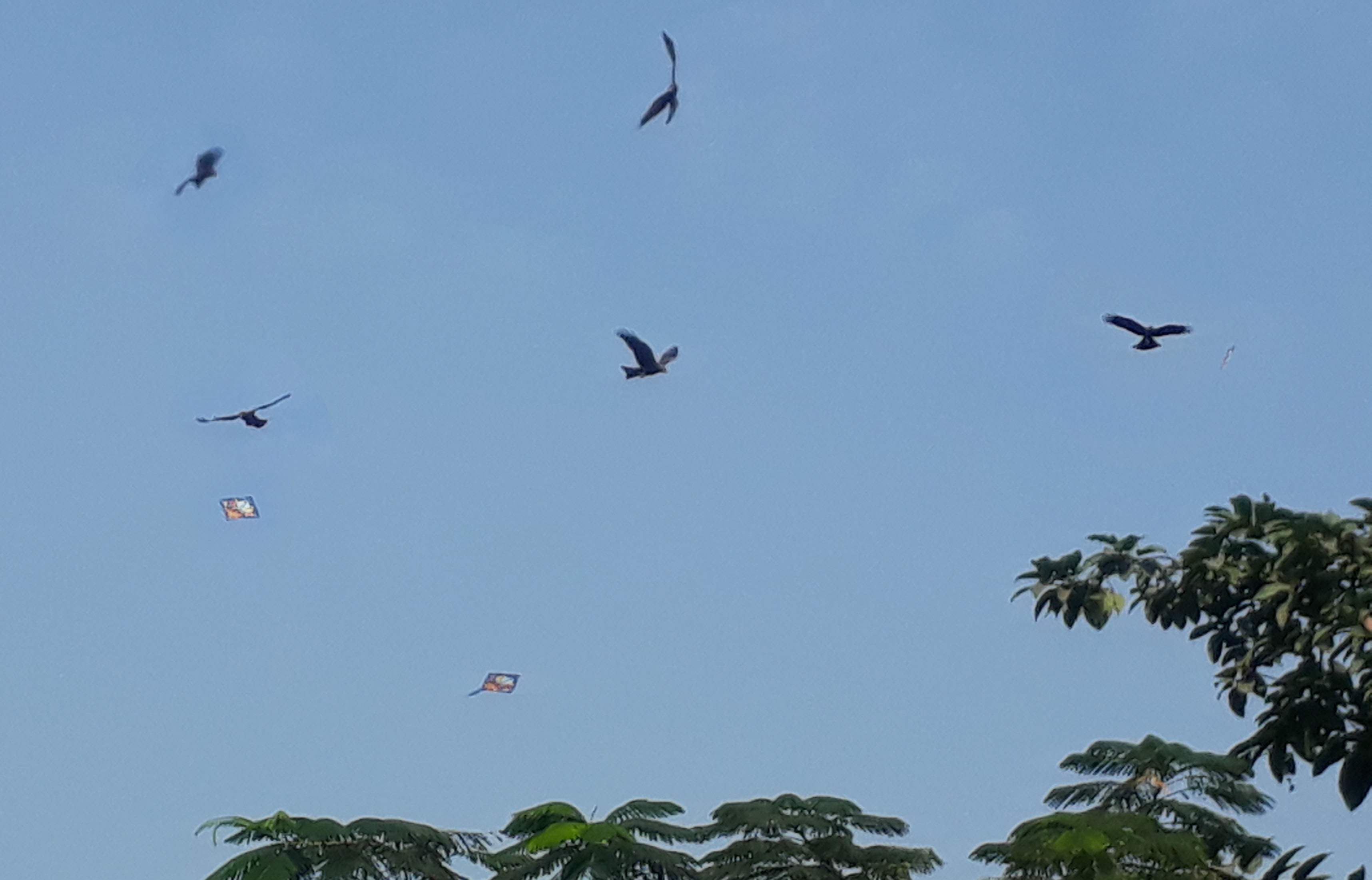
Looking over Railway Settlement Secondary School into the sky near Cuttack railway station during a sunny day was mind boggling as it was Black kites Vs paper kites as the former were flying from all irections to catch the later unsuccessfully.
Black kite, a medium-sized bird of prey known for its V-shaped tail, has a small head, short beak, partly bare face and long narrow wings and tail. Kites belonging to Accipitridae family usually are found worldwide in warm regions. Some kites are scavengers but eat rodents, reptiles, insects etc, few prefer snails. They are buoyant in flight, slowly flap and glide with wings angled back. Of several species, Brahminy kites are found along the rivers and Black kites seen flying over any city.
Paper kite, resembling a hovering bird to get its name, has a long and varied history being flown for recreation, entertainment, art or as a competition. Different types of kites are flown individually during festivals worldwide. Kite evolved into fighter kite known as patang after its introduction in India and flown during Makar Sankranti on June 14.
It was a preparation for the ensuing Sankranti when every flyer would try to tear the thread of other fliers for their patangs to fly away without any direction as a symbol of victory. But, above two fliers were befooling the birds who considered the patangs as possible preys.
A paper kite consists of wings, tethers, anchors often have a bridle and tail, technically i“a collection of tether-coupled wing sets”. Its wing surfaces react against the air to create lift and drag. Man-lifting kites were made for reconnaissance and entertainment but during development of first practical aircraft, the biplane.
A kite may have fixed or moving anchors that can balance the kite. Kites were invented in Asia but its origin not known though its oldest depiction was found in a Mesolithic period cave painting in Muna Island in Indonesia (dated 9500–9000 years BC) while China claims that 5th century BC Chinese philosophers Mozi and Lu Ban had invented it.
Scientific uses: Leading writer, printer, political philosopher, politician, scientist, inventor, humorist, civic activist, statesman & diplomat Benjamin Franklin in 1752 had published an account of a kite experiment to prove that lighting was caused by electricity. Alexander Grham Bell experimented with very large man-lifting kites as did the Wright Brothers and Lawrence Hangrave for research in late 1800s. Kites had a historical role in lifting scientific instruments to measure atmospheric conditions for weather forecasting. Francis Ronalds & William Radcliffe Birt had described a very stable kite at Kew Observatory in 1847 on trial for supporting self-registering meteorological instruments.
In 20th century many new kite designs were developed, including Eddy’s tailless diamond, tetrahedral, Rongallo wing, sled, parafoil and power for scientific purposes, especially in meteorology, aeronautics, wireless communications and photography. Rogallo wing was adapted for stunt kites and hang gliding while parafoil adapted for parachuting and paragliding. Rapid development of mechanically powered aircrafts diminished interest in kites. World War-II saw limited use of kites for military purposes (survival radio, Focke Achgelis Fa 330, military radio antenna).
Lightweight synthetic materials (ripstop, nylon, plastic film, carbon fiber tube& rod) are used for kite making while synthetic rope and cord are used as bridle and kite line to make kites now mostly for recreation.
Designs often emulate flying insects, birds, and other beasts, both real and mythical. The finest Chinese kites are made from split bamboo (usually golden bamboo), covered with silk, and hand painted. On larger kites, clever hinges and latches allow the kite to be disassembled and compactly folded for storage or transport. Cheaper mass-produced kites are often made from printed polyester, not silk.
Tails are used for some single-line kite designs to keep its nose pointing into the wind. Spinners and spinsocks can be attached to the flying line for visual effect. There are rotating wind socks which spin like a turbine. On large display kites these tails, spinners and spinsocks can be 50-feet long or more.


 20
