
By M. Jayashankar & Mahendra Devanda
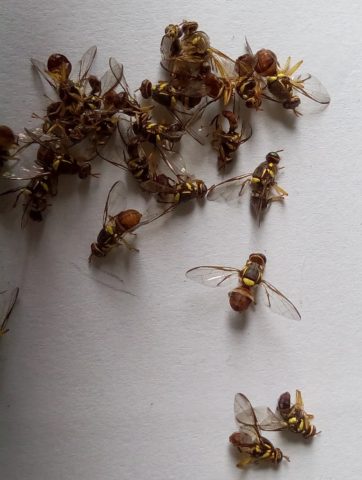 Grapes, banana and mango are fruits exported in significant proportion from India and we stand second in global fruit production arena. There has been gradual increase in the area under horticulture so has annual production. But pest incidence is a major threat to fruit production. The Oriental Fruit Fly (OFF), Bactrocera dorsalis (Hendel) is a highly invasive and destructive pest of fruit identified as one of the five most important pests of agriculture in South East Asia.Native to Asia, OFF is now found in at least 65 countries, including parts of America and Oceania, and most of continental Africa. Increasing international tourism and trade has facilitated its invasion to a new area and is influenced by changes in climate and land use. Climax, a bioclimatic modeling has assessed the bio-physiological aspects of OFF to generate the condition in which the species can ideally exist. It was evident that majority of the currently suitable areas such as southern and NE states would continue to remain suitable for OFF with increasing global temperature. Of about two hundred species of fruit flies currently known from India, the main species of contention is the off, one of the most destructive fruit fly pests occurring in the major mango growing belts in India, impacting yield of the King of fruits!. Its appetite for devouring fruits puts 478 fruit and vegetable crops to risk, apricot, avocado, banana, citrus, coffee, fig, guava, loquat, mango, rose apple, papaya, passion fruit, peach, pear, pineapple and tomato. Infestations of 50–80% have been recorded in some fruit crops. Female flies insert eggs under the skin of fruit using their syringe like ovipositor in clusters of 10 to 50 laying more than 3,000 eggs during her lifetime (many months!).
After introduction, it can easily disperse as it has a high reproductive potential, up to 10 generations per year, rapid dispersal ability and a broad host range. This agility has made the OFF a quarantine significance in most countries of the globe. Its economic impact would result primarily from the loss of the export markets and the costly requirement of quarantine restrictions and eradication measures. Hatching within a day leg less white larva voraciously feed the fruit pulp, gather mass to mature and drop to the ground to pupate in the soil, emerging as winged adults in about ten days. Most flies emerge in the early hours of the day to start their life journey crawling up through the soil. The color of the fly is mostly yellow with dark markings on the thorax and abdomen. About nine days are required for attainment of sexual maturity after the adult fly emerges. Females begin to lay eggs about 8 days after emergence. Development from egg to adult under summer conditions requires about 16 days. They prefer to deposit eggs in old egg deposition lesions and in ripened fruitbut immature ones may also be attacked. Larval feeding in fruits is the most damaging. Infested young fruit becomes distorted, callused and usually drop; mature attacked fruits develop a water soaked appearance. The larval tunnels provide entry points for bacteria and fungi causing fruit rot.
Phytosanitary measures include inspection of consignments of fruits for symptoms of infestation from countries where B. dorsalis occurs. Number of methods has been employed in attempts to reduce or prevent damage by this pest. Of utmost importance and effectiveness is field sanitation to reduce reinfestation. All unmarketable and infested fruits must be destroyed. Crops should be plowed under as soon as harvest has been completed. Insecticide bait sprays are applied to the crops to be protected with which the adults usually females are closely associated provide good rates of kill. B. dorsalis can be monitored by traps baited with male lures serving as early warning systems of detection and inspection. The trap consists of methyl eugenol used along with an insecticide which attracts only the males of certain species of Bactrocera, and therefore is called male annihilation technique (MAT). In the absence of males, females fail to procreate, and hence fruits will be free of infestation. The traps can be used for both as early monitoring and management attracting OFF and the other species over a range of up to 1 km!. These mini-jets are good fliers and fly up to 24 miles away from their release point!. A bottle trap designed by Indian Institute of Horticultural Research (IIHR), Bengaluru is a wealth made out of waste indeed, which was installed in the Residential quarters of Arunachal Pradesh Regional Centre of ZSI at Senki valley. It is made of disposable mineral water bottles into which the methyl eugenol imbibed plywood dispenser is put and suspended vertically inside the bottle with two vents providing entry points to fruit flies. Thirty one male flies were recorded in the bottle on the first day; the catch was high during dusk the mating time of the flies and is comparatively less during day. Adult flies were trapped in pilot records in some parts of Itanagar viz., MOWB-II, Senki View, confirming their distribution in the region. They need energy to fly-locate a partner and procreate. This fly is central to quarantine, international trade and pest management.


 20
