By Pradeep Kumar
Reversing dependence
syndrome only panacea
With COVID-19 has slashed GDP growth regrettably to 2% for fiscal year ending March 2021 from 5.1% projected earlier, a 30-year low forecasted by Flitch Ratings, it calls for all Indians to stand united and work as a team to take the nation ahead.
The situation again demands united efforts as growth of world’s second-biggest economy (China) for 2020 was forecast at 2.5%, according to the median of 62 analysts surveyed by Reuters, which would mark the weakest clip since 1976, the final year of the decade-long Cultural Revolution that wrecked its economy.
Undoubtedly, this was impact of COVID-19. But the revival process would be easier and faster if Indian IT industry accelerates production to become self-reliant by reversing dependence on China.
That is a sharp easing from a 6.1% gain in 2019, and is below the 5.4% China’s growth forecast in March poll. It also marks a reversal from 3.5% growth forecast in last survey. The projected 2020 growth would be weaker than 3.9% rate in 1990, when its economy was hit hard after Tiananmen crackdown in 1976, but still outperform a 1.6% contraction.
I was surprised and shocked when a professor of Rajiv Gandhi University, of course from Odisha, recently asked to me write against facilitating the working forces to return to their native states. But he was absolutely right as the working forces are backbone of development anywhere in India. It is more relevant for Arunachal Pradesh which is yet to adopt work culture.
That is why amid the migrants leaving their work places due to COVID-19 pandemic, Bengaluru Police Commissioner Bhaskar Rao, in a video message, urged stranded Odisha workers not to leave the city during nationwide lockdown and stay safe where they are as Karnataka Govt is committed to take care of them.
Karnakata Chief Minister BS Yediyurappa had assured his Odisha counterpart Naveen Patnaik that the state will look after Odia migrants stuck in various parts of the city due to lockdown, he said, adding: “Stay here and resume work. I urge everyone not to panic. We will provide all of you the best services here.”
“During discussion with Odisha CM Naveen Patnaik, Karnataka CM BS Yediyurappa has committed to provide all sorts of assistance to Odia people in Karnataka,” the IPS officer told in the message.
“Don’t panic. Both Centre and State Government are with you. We are trying to reach out all the workers stranded here,” he said and suggested them to be in touch with the Bengaluru Police if they face any problem during the period.
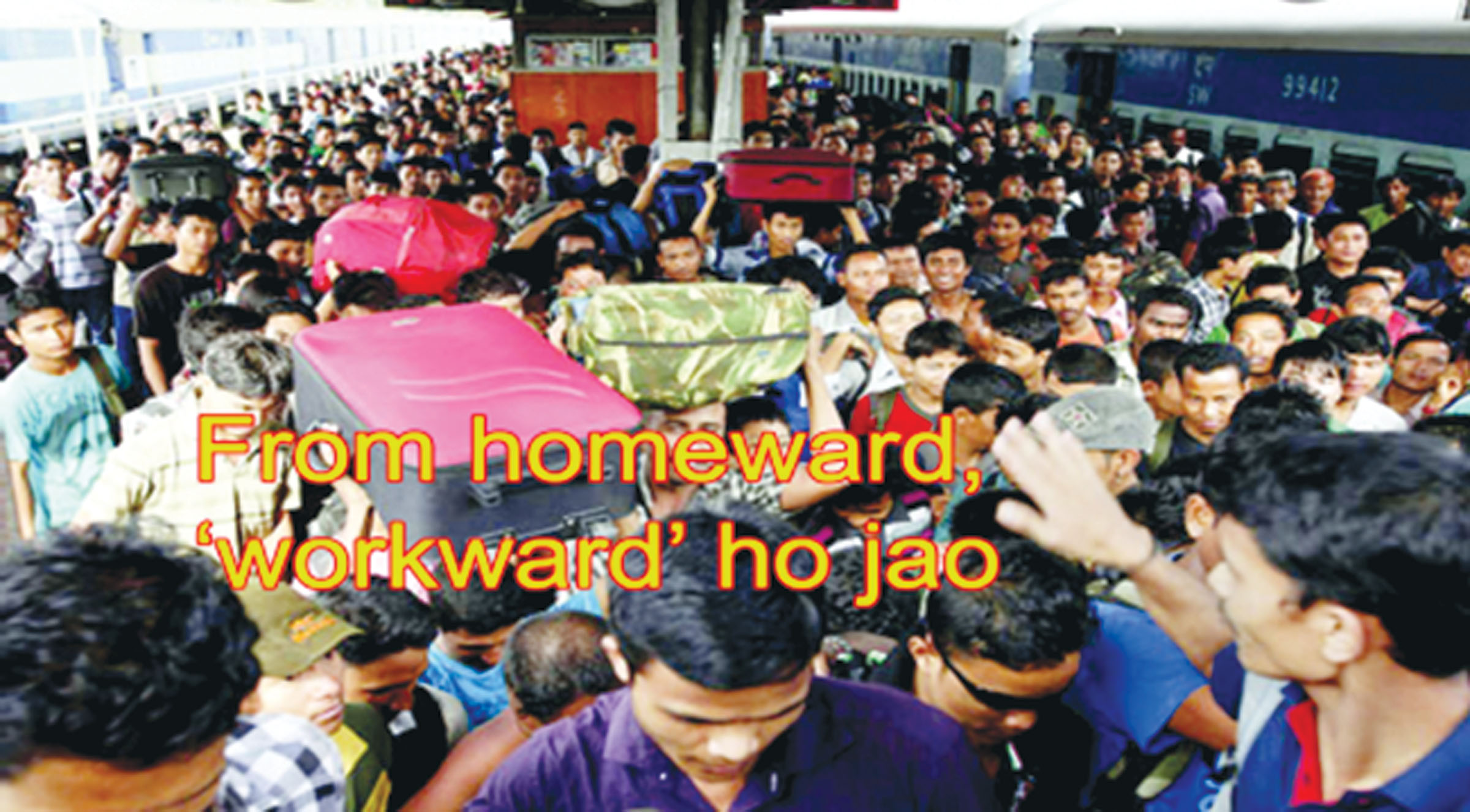
This only reminds about worst post-independent exodus of lakhs of NE people including students in August 2012. Then Arunachal Pradesh Chief Minister Nabam Tuki had spoken to Union Home Minister Suchil Kumar Shinde, his Karnataka counterpart Jagadish Shettar and Maharashtra counterpart Prithviraj Chavan on 17.08.12, who informed that there was no incident and the exodus was a result of baseless rumours.
A goodwill team led by then MP Takam Sanjoy, on my plea, as emissary of CM Tuki along with Arunachal Bhawan DRC KN Damo and Congress leader Likha Maj was first to tour Bangalore, Hyderabad, Pune and Mumbai to defuse the situation and assist local administration to bring back normalcy.
The mass exodus of working people and students of NE states during four days beginning 15.08.12 was due to rumours that they would be attacked as a fallout of the ethnic violence in Assam, and because of provocative SMSes and Facebook campaign launched by Pakistan as proved later by the MoHA. About 30,000 people flew from the country’s IT capital, Bangalore, alone. The loss caused to the nation and man-hour lost was huge.
This has brought to limelight the gospel truth about contributions of NE people in nation building with Karnataka Deputy Chief Minister R Ashoka himself informing that about 3.5 lakh NE people live in Bangalore, of whom only 25,000 had fled while the rest lived as usual. Moreover, Central Tibetan Administration Home Minister Gyari Dolma called on Ashoka to thank him for providing protection to about 45,000 Tibetans living in Karnataka.
Ashoka himself had toured NE states at the invitation of Assam CM Tarun Gogoi and leaders of Nagaland and Manipur to persuade the NE people to return. This had proved the importance and caliber of Northeasterners.
The huge natural resources, land mass and manpower is the real strength of NE region (NER). Mumbai and Kolkata have lost their status as financial and industrial capitals because of deluge and bandh culture in the last decade respectively. The NER located near South East Asia alone could contribute hugely to India’s GDP growth, lowered to 6.5% from the targeted 8.5% in 2012.
I recall Prof Atul Sarma, former Arunachal University (RGU) VC and then 13th Finance Commission member, who had pricked the psyche of all those who matter by advocating a ‘pan-Arunachal’ or ‘pan-NE’ identity for the fact that NER represents 19.3% of India’s total land area and 3.8% population. That is why he had called for projecting NER as single unit and market. Though there were few takers of his logic then, Governor JJ Singh was the first to predict that NER is poised to be India’s recruitment hub soon.
“The mass exodus has made us one and we spoke in unison”, while Sanjoy had urged one and all to be NER ambassadors, reflecting its rich culture and traditions while behaving like Romans in Rome. It is worth mentioning that Meghalaya CM Mukul Sangma in his inaugural address to 4th NE cultural festival at Itanagar had also stressed on unity, saying: “It is high time that all NE states come together to showcase rich cultural heritage of the NER.”
The media, as crazy as ever to sensationalize, paints all negativities aspects of the NER for the sake of TRPs and more ads but those who have ever visited the region know the truth –hospitable NER people live in the lap of nature without begging and no guest ever remains hungry. How many of the mainland journalists, particularly electronic, have visited the remote and inaccessible parts of the NER? Perhaps a handful… but they cause more harm to the NER people than good through their provocative and biased coverage without even realizing their social responsibility, what to talk of ethics.
It is high time to for us to adopt a pan-Indian identity respecting preamble of the Constitution: WE, THE PEOPLE OF INDIA, having solemnly resolved to constitute India into a SOVEREIGN SOCIALIST SECULAR DEMOCRATIC REPUBLIC and to secure to all its citizens: JUSTICE, social, economic and political; LIBERTY of thought, expression, belief, faith and worship; EQUALITY of status and of opportunity; and to promote among them all; FRATERNITY assuring the dignity of the individual and the unity and integrity of the Nation; IN OUR CONSTITUTE ASSEMBLY this twenty-sixth day of November, 1949, do HERE BY ADOPT, ENACT AND GIVE TO OURSELVES THIS CONSTITUTION.
‘United we stand, divided we fall’ is a common adage whose value the NER people had realized the hardest way in the face of the worst adversity during their mass exodus. This only reestablished my view – ‘They do not know what they need to know’ which I wrote on the observation of Jawaharlal Nehru University Vice Chancellor Prof BB Bhattacharya in his 10th RGU convocation address in February 2009.


 20