Removal of sand from Sun temple Konark begins
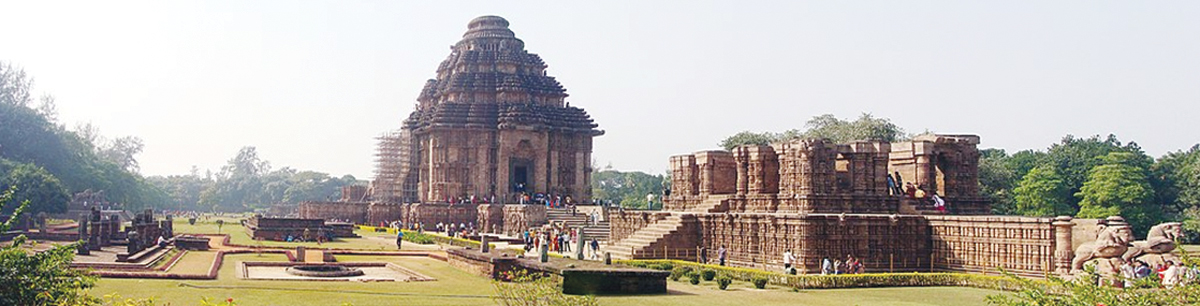
The ASI after 120 years has started removing sand from Jagmohan of Sun Temple in Konark on Sept 8.The sand filling was done by the British in 1903 to provide stability to the monument.
“ASI is quite confident of removing the sand successfully and we are taking the help of a private organization for technical know-how. ASI has the expertise in preserving and restoring old monuments successfully. Today we started construction of a working platform which will help in drilling, taking up and bringing materials from the temple top,” said ASI Odisha circle superintendent Arun Malli. The ASI has targeted to empty the sand in three years and tied up with BDR Construction Pvt Ltd to carry out the work.
Mallik said, in the last two years ASI has conducted several studies and surveys of the structure, including laser scanning to get an idea of the structure inside. The edifice of 13th century CE as standing now has been studied by the experts so far as the internal geometry, structural condition, foundation with the help of modern technical devices. Moreover, opinions also obtained from the experts including renowned archaeologists, engineers and architects through seminars regarding removal of sands from inner side of the Jagamohana.
“Whatever we have studied so far is in pictures and from outside. Unless we open it, we don’t know what the real challenges are. A 6thX5th tunnel will be opened from the top of western side of the Jagamohan near the first pidha to create a passage. The main aim is to stabilize the structure and we are taking utmost precautions while evacuating the sand. After completion of the work the esteemed visitors of the globe will be get an opportunity to have a glance,” he pointed out.
Sources said, in a bid to provide structural stability to the crumbling structure the 70th high Jagmohan was sealed with sand under the instruction of Lieutenant Governor of Bengal J A Bourdillon in 1903.“Starting from 1950 there has been a number of high-profile meetings and investigations involving specialists deputed by UNESCO and there are suggestions to remove the sand from the Jagamohan several times earlier. Though late the ASI has taken the right step and started the process of removing the sand filling. We welcome the step,” said Anil Dey, convenor of Kalinga Heritage Preservation Trust.
The ASI had accepted a proposal to remove sand from inside the Konark Temple, the only UNESCO World Heritage Site, at a national conference on ‘Conservation of Sun Temple’ attended by then Union Culture Minister in February 2020. “It is indeed a bold decision taken by the ASI and we are hopeful that they will be successful in their endeavour. The sand removal was pending since long. There is imminent threat to the monument from the sand inside it so it is very important to remove it,” said Anil Dhir, Indian National Trust for Art and Cultural Heritage (INTACH).
Konark Sun Temple or Black Pagoda, a 13th century CE (year 1250) temple at Konark, about 35-km on coastline of Puri, dedicated to the Hindu God Surya (Sun).The visible ruins of the temple complex is a 100-foot high chariot with immense wheels and horses, all carved from stone. Once over 200 feet high, much of the temple is now in ruins, in particular the large shikara tower over the sanctuary; at one time this rose much higher than the mandapa that remains. The structures and elements that have survived are famed for their intricate artwork, iconography, and themes, including erotic kama and mituna scenes. Also called the Surya Devalaya, it is a classic illustration of the Odisha style of Kalinga architecture.
The original temple had a main sanctum sanctorum (vimana), which is estimated to have been 229 feet (70 m)[ tall. The main vimana fell in 1837. The main mandapa audience hall (jagamohana), which is about 128 feet tall, still stands and is the principal structure in the surviving ruins. Among the structures that have survived to the current day are the dance hall (Nata mandira) and the dining hall (Bhoga mandapa).
The name Konark (Koṇarka) derives from Sanskrit word (Koṇa – angle and Arka – sun). The Arka refers to the God Sun god. The Sun temple of Konark, the Puri Jagannth temple and the Lingaraj temple of Bhubaneswar form a bilateral triangle. Konark temple forms one angle (angular point of the triangle).[ This probably refers to the southeast location of this temple either within a larger temple complex or in relation to other sun temples on the subcontinent.
The Sun Temple of Konark, a massive, breathtaking, magnificent and awesome ancient gift of India to world heritage, is about 750 years of history that had culminated Odisha’s temple architecture. One of the most stunning examples of religious art, but presents disrepair though under conservation for last 120 years and the Archaeological Survey of India claims it as among the best looked after monuments; however, its conservation history is uneven.
A marvellous metaphor of time and space, the ancient temple is decaying, victim to advancing stone erosion and weathering, which have already blunted the fineness of the carved figurines and taken their toll on the soft stone. Salt action, wind, humidity, algae and fungal growth have all contributed to the damage. Fissures have appeared, stone slabs are breaking off and the figures, as they erode, have lost much of their pristine beauty.
In was in December 1900, after Lt Governor Sir John Woodburn visited the place that efforts were taken to restore it to its grandeur. By April 1901, the archaeological surveyor T Bloch had unearthed the mammoth structure and the sheer size and splendour of its structure and intricate carvings were once again seen.
In 1924, the Earl of Ronaldshay proclaimed the newly-revealed temple to be “one of the most stupendous buildings in India, which rears itself aloft, a pile of overwhelming grandeur even in its decay”.
More than 11 reports were prepared by different authorities in different times after this. Most of them just gathered dust. The first report, prepared by Bishan Swarup, an engineer who worked at the site from 1901-04, stated that the edifice faced collapse and had it filled up with sand. Swarup had given detailed suggestions for the further upkeep of the temple, but these were just forgotten.
It was handed over to Archaeological Survey of India (ASI) in 1936 and carrying out conservation works since then.
The next committee, formed in 1950, was chaired by Chief Minister Biswanath Das and had on its panel C M Master, an eminent architect from Bombay. None of the recommendations was put in place.
The third committee was formed in 1953, this too under the chairmanship of Das, and the recommendation for erection of scaffolding was implemented.
In 1978, the ASI constituted the Konark Expert Committee (KEC) where, for the first time and a meeting chaired by its DG took serious view of the problem. After the collapse of five stone blocks from the main temple, structural conservation was undertaken between 1985-90 and based on this, scaffolding of some vulnerable sections was done.
In 1979, the UNESCO Experts Recommendation on Conservation of Konark was given to the Govt of India. After declaring it a World heritage Site, UNESCO once again appointed a committee headed by experts Sir B M Fielden and P Beckman in 1987. They described the state of the temple as alarming and advised immediate measures.
Italian expert Prof Ing Giorgio Croci made a structural analysis of Jagamohan in 1997. The committee’s recommendations included removing the sand. One of the suggestions was to drill a hole and send endoscopic cameras to assess the state of the interior of the temple.
No one knows for sure why the Konark temple disintegrated so rapidly in such a relatively short time. Various theories abound, some scholars think that the main temple was never completed. The collapse may also have been due to bad foundation and settlement, or natural catastrophes like cyclones, lightning & earthquake.
The temple was originally nearer to the seashore and its black pagoda was visible for miles. In fact the ancient mariners’ maps used it as a navigation point. The standing corner of the tower was further recorded by James Fergusson in 1837 C.E., who estimated its height as 140 to 150 feet, and Kittoe in 1838 C.E. estimated its height as 80 or 100 feet. This solitary remnant of the main temple fell in October 1848 due to a strong gale.
Rajendra Lal Mitra, while visiting the temple in 1868, mentioned it as only an “enormous mass of stones studded with a few peepal trees here and there”.
In 1906 large-scale plantation of casuarina and poonang trees was taken up in the direction of the sea in order to check the movement of sand-laden winds and thereby minimise their abrasive action. These tall trees were all destroyed in the super cyclone of 1999.
The authorities then planted cashew nut trees, which do not grow high and offer little protection from the sand particles carried by the wind. This has accelerated the erosion. Furthermore, the entire compound was paved with stone blocks, which stopped the natural sand percolation of rainwater, resulting in water logging of the temple every year.
Between accusations and counter-accusations, the condition of the structure continues to weaken. Acquiring a heritage tag is not sufficient in itself; it entails and imposes greater responsibility and cultural accountability. But our system in place is hardly responsive to the needs of culture.


 20