
By A O News Service
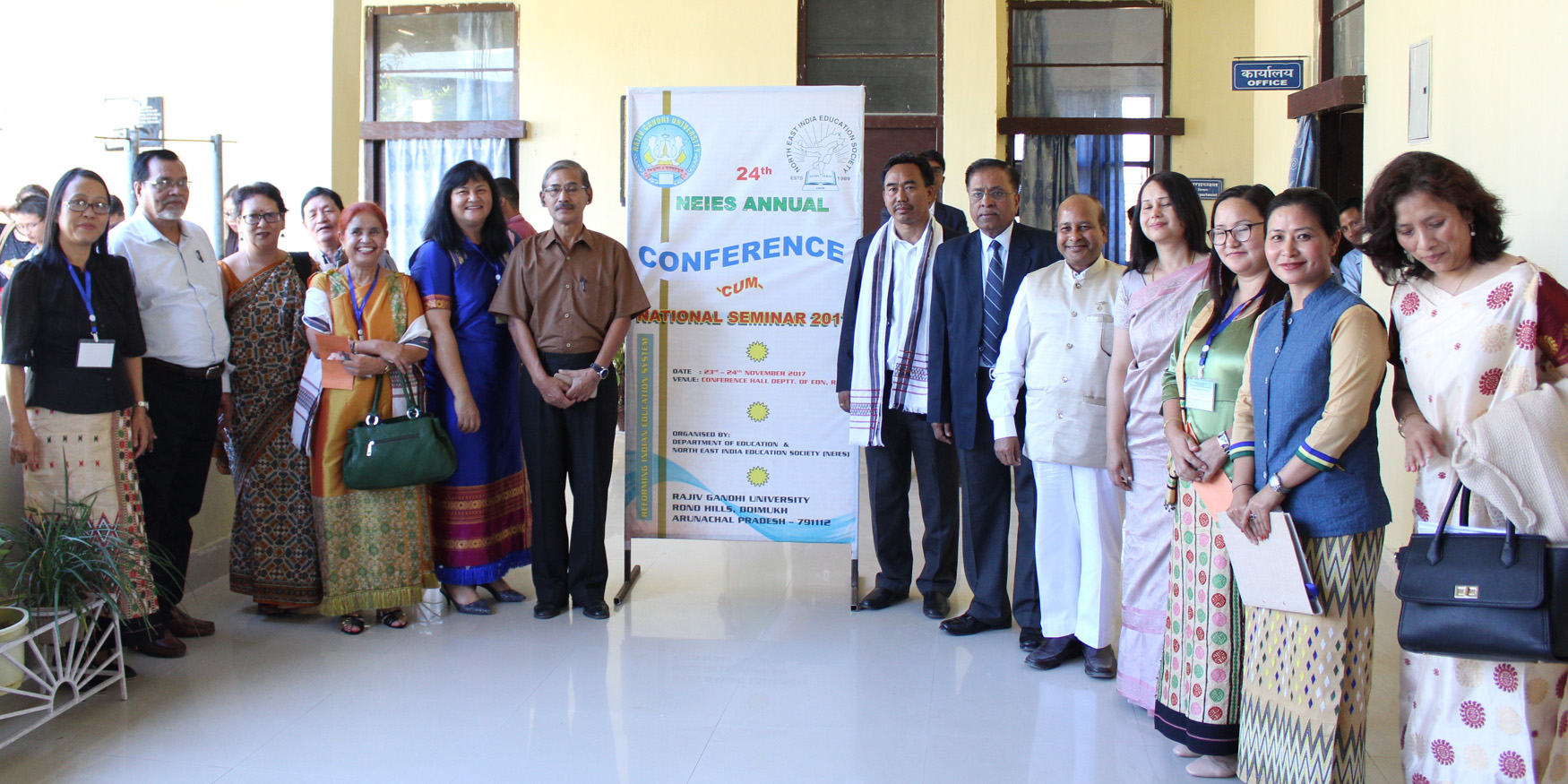
RONO HILLS | Nov 23 | In all 84 papers have been enlisted to be presented during technical sessions of two-day 24th annual conference-cum-national seminar of North East India Education Society (NEIES), which begun in the RGU campus here today.
While presenting his paper on ‘Reforming Indian education system’ sub-theme ‘Need-specific reforms need of all times’ senior journalist Pradeep Kumar said that from Gurukul to modern system, education has passed through many a trials and tribulations in India to fulfill the desires of knowledge-seekers. But undeniably present education system was evolved by the Britishers for their specific needs but not to spread education in true sense of its term.
“Though Congress party had struggled for independence but their resolutions favoured to adopt British system, institutions and education. But what India inherited is the colonial system the Britishers had evolved to rule India”. Former Lok Sabha secretary-general Dr. Subhash C. Kashyap, an expert on Indian Constitution, had told this author at Naharlagun on 20.12.13, he said.
“The British parliamentary system has 12 main characteristics and none is applied to Indian democracy. The first fallacy is that the vulnerable founding fathers of our system accepted it and it continues till date, he had reasoned. This means we defied and defaced the western concept of democracy”, Dr Kashyap, who has authored 100 books in English and Hindi and associated with the Parliament for over 37 years right from Nehru to Mavalankar time, had said to vindicate that present system is British system.
Hinting at present education system, he quoted CBSE chairman Vineet Joshi, to highlight the challenges confronting the nation. Supporting NEIES president Prof P K Gupta view for integrating vocations with academics, he said that though there are more than 700 universities, 35,000 colleges, about 4,000 odd engineering colleges, probably more than that the management schools but there is no credible accreditation system in higher education for which they are suffering.
Blaming the poor education for which of world’s youngest labour force in India only 6.4% is skilled. Thus, global NGO National Youth Project, of which H P Biswas is president and myself vcve president, had persuaded 20 opium cultivators of Anjaw district to cultivate large size cardamom. Their first harvest had yielded Rs 1.76 crore and this success story is uploaded to funding agency NABARD’s website. Slowly and steadily, numerous Anjaw residents turned into lakhpatis as buyers reached district HQs Hawai to buy badi elachi @ Rs 1,800 per kg and it is demanded in South Indian markets now at double the rate.
Educationist Dr Joram Begi, in his thesis—‘The growth and evolution of education in Arunachal Pradesh: A study in historical perspective’— had advocated that political interference should be avoided and schemes on feasibility criteria implemented for speedy growth of education, while a monitoring cell be set up for supervision, evaluation and feed backs to planners for evolving effective strategies . The nine-point recommendations included constitution of a commission of education to study the status of elementary, secondary and higher & technical education and recommend strategy to overcome various short comings and introduce innovations; establishment of board of secondary education for elementary, bureau of text books, mandatory creation of adequate posts before opening up or upgrading educational institutions at secondary levels, linking stipend to achievements and infrastructure development.
While the RGU, NERIST and NIT have become partners to develop need-based manpower, but recommendations of such seminars hardly yield any results. Because, present genre of lawmakers have redefined Democracy as “off the people, buy the people, far the people”, contrary to described by Abraham Lincoln as “….that government of the people, by the people, for the people, shall not perish from the earth”, threatening the root of this time-tested system.
Great fighter Abhimanyu, who while in his mother Subhadra’s womb had acquired the knowledge to enter the tactical Chakra Buhya during Mahabharat war when Arjuna was explaining to his wife, but could not explain the process to come out as she fell asleep. Abhimanyu was killed by Sapta Mahatahi during Maharbharat War as Krishna had taken his father Arjuna far away not to be his saviour. Totally exhausted horses of Arjuna’s cart had retired near Guwahati at a spot where Aswaklanta Temple stands tall today!
This is living testimony that education process, according to me, begins in mother’s womb and ends at the tomb as was proved by Abhimanyu.
Thus, the Mahabahart of education reforms would continue and many fighters would surface and disappear for the historians to record, but it would meet its goal it is made need-specific. If education needs to be reformed, it should aim at making people earnable to lead a happy life, he concluded.
However, Education Minister Honchung Ngandam who chief guest of the inaugural seminar and VC Prof Tamo Mibang, gave away awards to All the participants of multiple choice competition, themed “Legal rights of women”, conducted recently by education department under the aegis of National Commission for Women (NCW). Of the total 99 contestants, the winners included Limi Kamgo, Pol Sc, (1st); Mama Patum, Education, Mom Ajha, Political Science & Ajoy Bini, Education (2nd); Mohan Pathak & Sangita Sahu, Pol Sc, Parvati Boli, Geography, Baseng Tayeng, Education, Nang Sunantrani Mantaw, Education, Kesang Cheren Gyana, Sociology &. Dol Bahadur Thapa, Economics (3rd).


 20
