
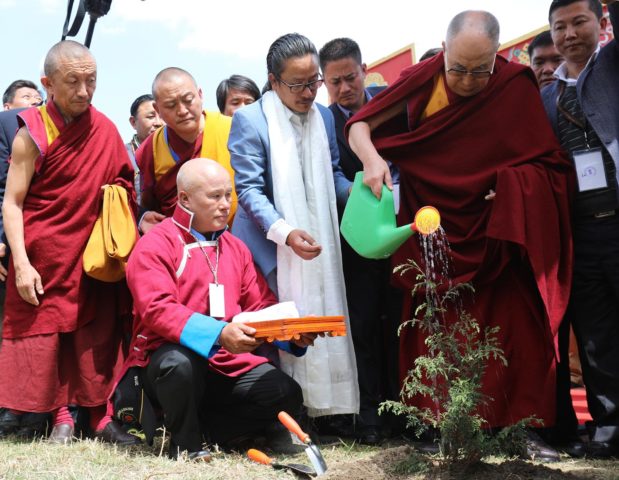
 TAWANG | Apr 09 | His Holiness, the 14th Dalai Lama today inaugurated the Dorjee Khandu Memorial Museum (DKMM) and adjacent Jangchub Chorten (JC) here in presence of Chief Minister Pema Khandu, Parliamentary Secretary Jambey Tashi, local legislator Tsering Tashi, monks, officials and family members of late Dorjee Khandu.
The Dalai Lama, who earlier in the day continued with his teachings at the Yid GaChosin Monastery ground, consecrated the museum and made an elaborate tour of the exhibits. Creative consultant Moji Riba guided him and explained in detail the sections and exhibits of the museum.
The DKMM and the JC, have been designed as a personal history monument of former state CM, late Dorjee Khandu, who passed away in a helicopter crash on 30.04.11, at the peak of his political career.
The museum is built with Rs 1.8 crore GoI grant, approved during then CM, late Jarbom Gamlin to attend the last rites of late Khandu. It was decided by the GoI that an apt memorial be created in honour of late Khandu, who had facilitated state’s phenomenal growth and development.
It was but a befitting tribute to the late leader, whose memorial museum was inaugurated by the Dalai Lama.
The central idea of the museum is help the visitors late Khandu’s personal life journey as well as his unique achievements.
Gallery 1 and 2 uses a mix-media blend to bring to its visitors a collection of exhibits and information on late Khandu’s life and work. A key feature of Gallery 1 displays the 32nd Kalachakra held at Bodh Gaya, Bihar in 2012. The event was one of Buddhism’s most significant religious events initiated by late Khandu and later organised by his family.
The Luguthang Arena at the centre of the gallery pays homage to those who perished in the fateful helicopter crash and contains exhibits and personal articles retrieved from the crash site. This arena also has a tribute to each of the four others who were on-board with him.
Gallery 2 is a large-sized panel on late Khandu’s vision for Arunachal Pradesh, highlighting the thrust areas of his tenure. It also highlights his idea of a ‘people first’ style of governance and emphasis on working collectively with ‘Team Arunachal’ spirit.
In keeping with the museum’s organic character, visitors are appealed to contribute videos, audio recordings and photographs they have of late Khandu, which will be incorporated into the content held in the museum.
A unique aspect of DKMM is changing exhibitions in Gallery 3, which is titled The Canvas of Changing Light.
Apart from permanent exhibits on the life and work of late Khandu, the museum will periodically host changing exhibitions on subjects and themes that were of interest to him. These exhibitions will be on-site for a year and later curated as a travelling exhibition to various towns of Arunachal Pradesh.
This gallery opens with an exhibition on His Holiness the 6th Dalai Lama Tsangyang Gyatso and seeks to understand the aura that surrounds one of the state’s most prolific historical figures.
The museum also pays homage to His Holiness the XIV Dalai Lama and features an arena that depicts his journey into exile in India in March 1959, and with it, the return of the Dalai Lama to Tawang as prophesied by His Holiness the Sixth.
Appreciating the project in remembrance of the late leader, who was personally very close to him, the Dalai Lama obliged to leave imprints of his hands permanently on a special plate put up in the museum with his portrait and that of the Sixth Dalai Lama.
The Dalai Lama, who planted a tree sapling in the premises of the museum, earlier visited Urgyeling Monastery, the birthplace of the 6th Dalai Lama Tseyang Gyatso. (PRO)


 20
