By Pradeep Kumar
ITANAGAR, Apr 25: Geological phenomenon, particularly repeated earthquakes recoded in Arunachal Pradesh, located in seismic zone-V, has scientific reasons.
A moderate earthquake in 5.9 on Richter scale stuck India on Wednesday with 40-km south east of Aalo as its epicenter, the same magnitude quake was also reported this week, this month and this year Aalo as its epicenter. India recorded one earthquake in past 24 hours, another in past 7 days, 2 earthquakes in past 30 days and 12 earthquakes in the past 365 days.
However, a strong 6.3-magnitude earthquake also struck at 4:15 AM on Wednesday, jolting Medog County in Nyingchi city in Tibet close to Arunachal Pradesh in India, authorities said.
Reasons: Because, India Plate is currently moving northeast at 5 cm per year and the Eurasian Plate is moving north at only 2 cm/yr. This is causing the Eurasian Plate to deform and the India Plate to compress at a rate of 4 mm/yr (0.15 in/yr).
The collision with the Eurasian Plate along the boundary between India and Nepal formed the orogenic belt that created the Tibetan Plateau and the Himalaya Mountains, as sediment bunched up like earth before a plow.
As tectonic movement is one of the most important subjects for in-depth studies, ‘Siang Window’ has been drawing earth scientists from across the globe to Arunachal Pradesh.
This I had reported – ‘Siang window’ attracts earth scientists for studies, Arunachal ki gowd sey on 19.03.08.
‘Siang Window’ is a new rock formation over rocks formed millions of years ago and could throw light on the tectonic movement of the earth. It is an opening, as the name suggests, which could help the researchers peep through and learn the developments taking place in the crust for millions of years, according to Prof. Jonathan Aitchngton, head of the department of geology and earth science, University of Hong Kong.
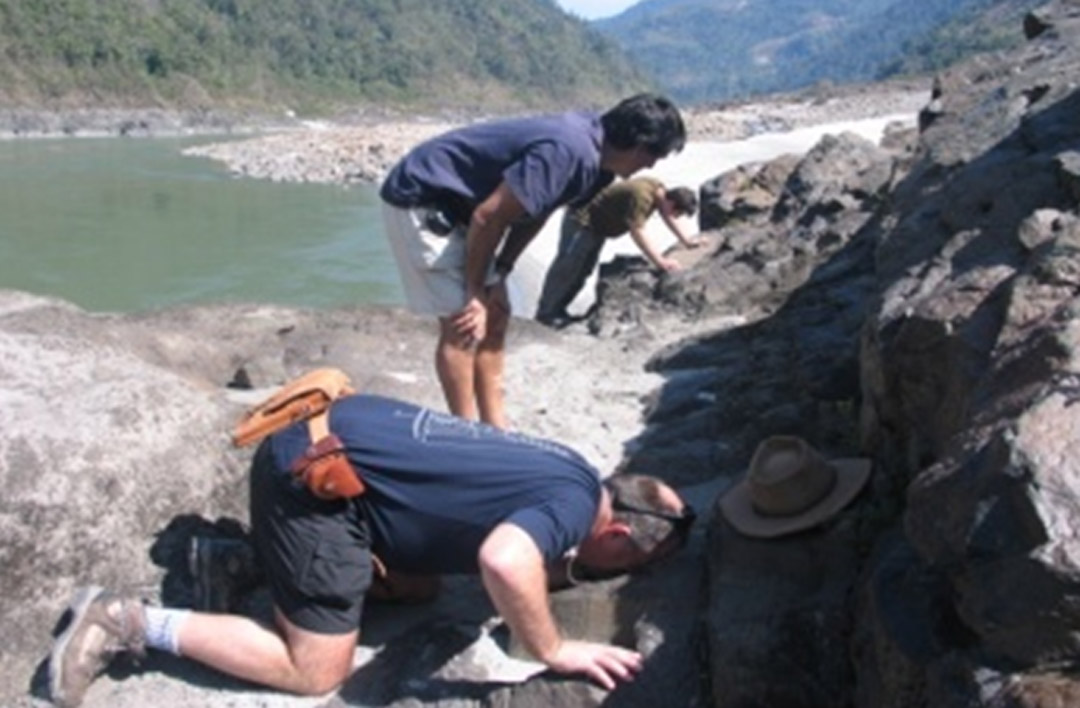
Prof. Jonathan, heading a three-member team as part of a research group, toured the right and left bank of Siang river from Pasighat to Yingkiong for 10 days to collect evidence, particularly fossils to support their study, tour operator Oken Tayeng, who escorted them, had said this editor.
The team, including Jason Ali and researcher Alan T Baxter, clad in shorts, trudged through the river bed at various places to look for evidence with piercing eyes as “I watched them with curiosity,” Tayeng added.
About 90 million years ago, subsequent to the splitting off from Gondwanaland of both Madagascar and India, the India Plate split from Madagascar in the late Cretaceous Period. It began moving north, at about 20 cm/yr (8 in/yr), and began colliding with Asia between 50 and 55 million years ago, in the Eocene epoch of the Cenozoic Era. During this time, the India Plate covered a distance of 2,000 to 3,000 (1,200 to 1,900 mi), and moved faster than any other known plate. In 2007, German geologists determined that the reason the India Plate moved so quickly is that it is only half as thick as the other plates which formerly constituted Gondwanaland.
That was why an 11-memebr team from the University of Washington’s department of earth science headed by Prof. Barnad Hallet had conducted studies on volcanic rocks.


 20