
By Pradeep Kumar
Beyond the Horizon
The Apatanis, descendants of the Abotani, are lauded for their unique agricultural practice, termed by Food and Agriculture Organization of the United Nations in 1980s as best traditional practice across the world.
The Apatanis, mostly women, right from dawn to dusk, remain glued to their agricultural fields resulting in higher yields. It is worth mentioning here that noted anthropologist Haimendorf, in his first book in 1962 had made the world aware of this unique sustainable agro-ecosystem of the Apatanis, whose knowledge is transmitted orally from one generation to another. However, around 1960s, a new system of fish farming was introduced along with the traditional paddy cultivation for which they are famous.
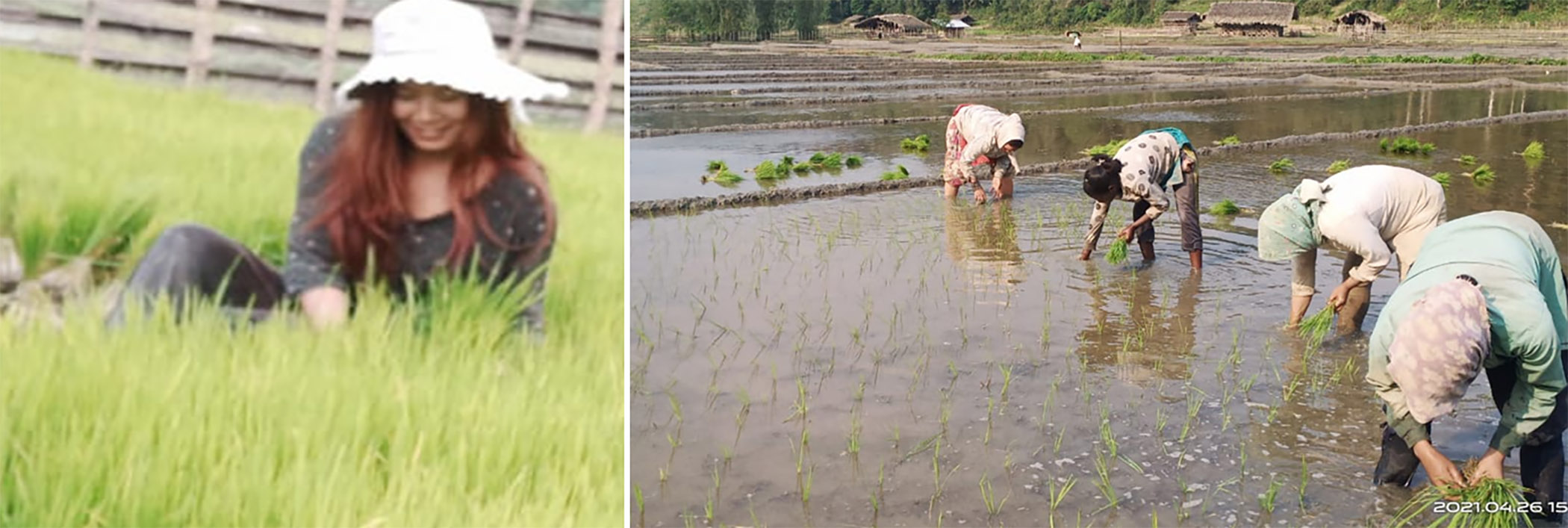
But, information received from Tadin village, about 25-km from West Siang headquarters Aalo, was encouraging. A Galo family was engaged in planting paddy plants. Topi Tashi, a young girl, who graduated from DNGC, was assisting her mother Romniya Tashi and two other relatives in the field.
Their rich fields yield yearly 100 quintals paddy and the traditional storage (locally called nakum) is still full with last year’s produce and no space for the next harvest. Galos, also descendants of the Abotani, seemingly are toeing Apatani mantra.
This Himalayan state, spread in 83,743 km² with only 13, 82, 611 population (2011 census), has enough land lying idle. Thus, Deputy Chief Minister Chowna Mein has been exhorting the indigenous communities to make best use of these idle lands to become self sufficient in food requirements to end dependence on outside supply.
Thus, the state government has launched ‘Local for Vocal’ scheme to encourage local farmers to use vast untapped land to boost agri-horticulture production for self sufficiency. This coincidentally coincided with Atma Nirbhar Abhiyan launched by the central government.
There are many examples of poor farmers becoming rich by adopting cultivation in agri-horti sector. The Community Horticulture Farming for Livelihood Generation under Tribal Development Fund of a central PSU and implemented by National Youth Project in Anjaw district is one such shining examples.
Two farmers’ clubs with 22 locals were formed to cultivate large size cardamom. Its excellent first yield was not only sold for Rs. 1.76 crore but had made many farmers lakhpatis. This had prompted large number of farmers to adopt the cultivation leading to huge production to make Arunachal Pradesh second largest producer of large size cardamom in the country.
It may be recalled here that Agriculture, Horticulture, Animal Husbandry, Veterinary & Fisheries Minister Tage Taki on 13.11.19 had given away Excellence in Large Size Cardamom Productivity Awards of Spice Board of India for 2016-17, 2017-18 & 2018-19 to progressive farmers of India. The 1st prize was Rs one lakh, a citation & certificate each and 2nd prize – Rs 50,000, a citation & certificate each,
For 2018-19, the 1st prize was received by Ajumlu Bellai, Tafragram village, Anjaw, Arunachal; 2nd prize winners were Basan Rai, Lolegaon village, West Bengal and Tuk Yania, Tazgi village, Lower Subansiri, Arunachal while A M Nath Poudyal from Ptiew and Dhan Kumar Gurung (both from Sikkim) received certificates of merit.
For 2017-18, Nima Nampo, Rahung village, West Kameng, Arunachal won 1st prize; Choden Lepcha, Lingdem village, Sikkim & Jongnem Tangha, Longkey village, Changlang, Arunachal were 2nd prize winners.
For 2016-17, large cardamom grower Luki Lepcha, Lower Rongong, North Sikkim won 1st prize; 2nd prize went to Mandhoj Gurung of Upper Ladam, Kalimpong, West Bengal and Neelam Rena, Deed village, Arunachal.
Moreover, former visionary leader Setong Sena had revolutionized the agriculture & allied sectors for which the state had won Krishi Karman Award for three consecutive years since 2012-13.
Neighbouring Sikkim having uncanny similarities with Arunachal Pradesh is the best example. With 6.07 population (2011 census), Sikkim is India’s least populous state and the 2nd smallest one after Goa. Spread in 7,096-km, its economy is largely dependent on agriculture and tourism and as of 2011 it had 4th smallest GDP estimated at $730 million among Indian states
Terrace farming of rice and maize, millet, wheat, barley, oranges, tea and cardamom cultivation made the state an exporter and its economy grew very fast. Sikkim was first among NE states to be an organic state in 2015. Sikkim is India’s highest cardamom producer with largest cultivated area.
Moreover, the state has 31 Livelihood Schools to provide skill training to youth, like the CM’s Livelihood Mission School set up at Nampong in Changlang district by the NYP, funded by late Setong Sena.
The sooner Arunachalees realize their potential the better. It is time to reverse the trend – let rest of India come to Arunachal to procure agri-horti products instead of Arunachal doing so.


 20

