By Pradeep Kumar
The so called modern era development has been forcing human beings to infringe into own designated reserve forest areas resulting into man-animal conflicts.
There are numerous examples in Odisha’s Simlipal National Park (SNP) and Assam’s Kajirnaga National Park (KNP).
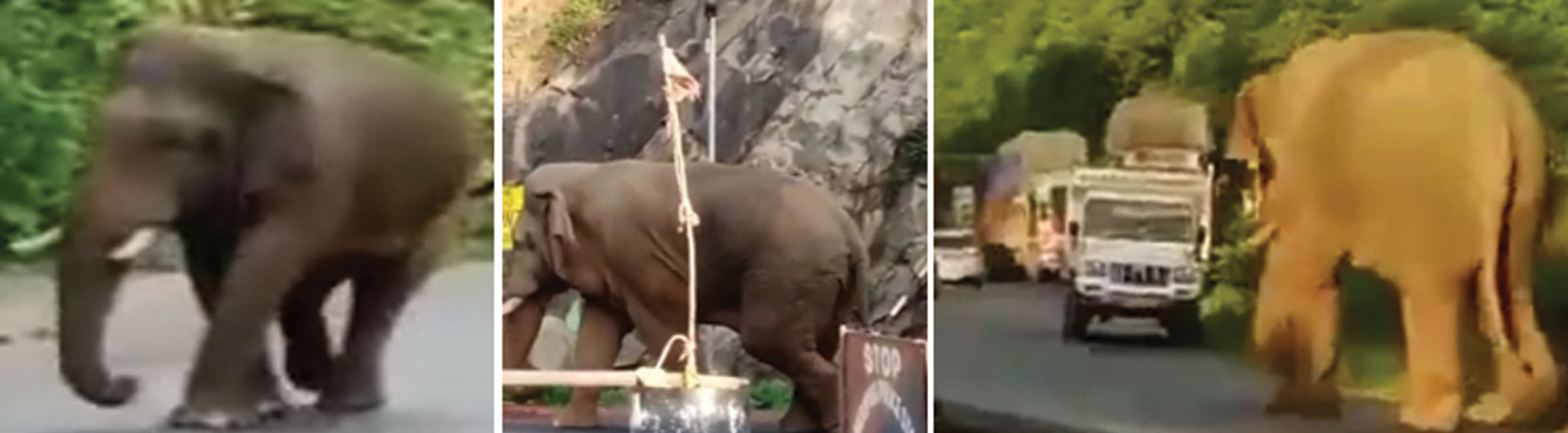
A huge tusker came out of dense jungle in Similipal forest under Bisoi police station of Mayurbhanj district of Odisha on Thursday, walked along the highway, crossing Maa Duarsuni Temple, hundreds of loaded tucks and passenger buses parked along Nation Highway-6.
The elephant did not cause any harm to either people standing to watch its majestic walk in the lush green forest, many followed to videograph, few while considering her as symbol of Maa Dwarsuni pleaded: “Maa go away, people are scared”. The tusker ultimately descended at a point to enter the jungle.
This road famed as Baman Ghati, part of Mumbai-Kolkata-Bangriposi Highway, records movement of large number of trucks transporting inter-state materials round the clock.
Of course, such tuskers surface on the highway frequently halting traffic movement for hours together. If history is any indication, the NH-6 is an encroachment of the reserve forest. The wild animals are still moving around in their designated areas while it is the human beings who are not only interfering but also disturbing their natural life.
The 1,949 km NH-6, India’s second longest highway that runs across the breadth of the country from Surat to Kolkata, passes through corridors around Melghat, Bor, Nagzira, Simlipal tiger reserves and seven other national parks and sanctuaries. It is also known as Asian Highway-46 or Mumbai-Kolkata Highway or Great Eastern Highway.
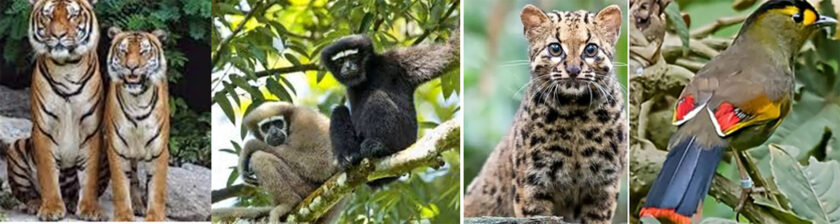
Simlipal covering 2,750 km2 is a National Park and Tiger Reserve besides an Elephant Reserve, including three protected areas – Similipal Tiger Reserve, Hadgarh Wildlife Sanctuary (191.06 km2) and Kuldiha Wildlife Sanctuary (272.75 km2). Simlipal National Park derives its name from the abundance of red silk cotton trees growing in the area. The SNP is home to total of 42 species of mammals, 242 species of birds and 30 species of reptiles, including major mammals Bengal tiger, Asian elephant, leopard, sambar, barking deer, gaur, jungle cat, wild boar, and chausingha(four horned antelope) and common langur. It has a sizeable population of reptiles, which includes snakes and turtles. The “Mugger Crocodile Management Programme” has helped Mugger crocodile to survive and flourish in and on the banks of Khairi River.
Simlipal Elephant Reserve originated mainly as a hunting ground for the royalty. It was formally designated a Tiger Reserve in 1956 and under Project Tiger in May 1973. “Mugger Crocodile Scheme” was started in 1979 at Ramatirtha, Jashipur. The state Govt declared Simlipal as a wildlife sanctuary in 1979 with an area of 2,200 sqkm. Later in 1980, the state Govt proposed 303 sqkm of the sanctuary as a national park. Further in 1986, area of the national park was increased to 845.70 sqkm. While the GoI declared Simlipal as a Biosphere Reserves in 1994. UNESCO added this national park to its list of Biosphere Reserves in May 2009. There are 10,000 people living in 61 villages in the forest. That is why Simlipal is yet to be declared a full-fledged park, despite its having the status of one of the 18 Biospheres of India.
The KNP, established in 1905, which hosts two-thirds of the world’s great one-horned rhinoceroses, a World Heritage Site, is known for its rich flora and fauna. Declared a Tiger Reserve in 2006, the park is home to large breeding populations of elephants, wild water buffalo and swamp deer beside recognized as an important bird are by Birdlife International for conservation of avifaunal species. Located on the edge of Eatern Himalaya biodiversity hotspot, the park combines high species diversity and visibility.
But, NH-37 bisects the KNP, disturbing movement of wild animals. At least four animals – three hog deers and one leopard – were killed on being hit by speeding vehicle on NH 37 passing through KNP on June 18, 2022. A rhino (in pic) was injured on the NH on being hit by a speedy vehicle on 13.08.21.
The animals usually cross the NH during flood season in search of high lands or to move to the hills of Karbi Anglong to take shelter. The KNP faces flood every year during monsoon and many animals die either drowning or by vehicle hit.
Surprisingly, animal death by vehicle hit continued in the park area despite the authorities has set a speed limit of 40-KMPH for all vehicles passing through the KNP area, particularly in nine designated animal corridors.
The Centre’s plan to build a 35-km longX11-metre wide flyover at an estimated cost of Rs 2,600 crore over NH-37 to protect wild animals including the endangered one-horned rhinos has remained in limbo.
Though the Wildlife Protection Act 1972 envisions protection of wild animals, birds and plants and for matters connected therewith or ancillary or incidental thereto, but who bothers (?) as the Act is hardly implemented.


 20