Bugun Liocichla
Beyond the Horizon
By Pradeep Kumar
Though Arunachal Pradesh boasts of majestic hornbill birds, but this Himalayan state spread in 83,743 km² areas from foothills in 7979 feet from sea level to lush green and snow clad mountains of 15,200 feet tall and guarded by armed forces.
The state, which boasts of over 867 rich varieties of birds, including endemics (1), globally threatened (50), introduced (1); rare and uncommon species of around 425 to rank 2nd in India after Assam. Thus, avi tourism is conducted in the state as rich diversity of birds in the wildlife sanctuaries and the national parks is beyond comprehension
Special bird tours are organised in EWS for bird enthusiasts to see
Therefore, tourists traversing this “Land of Orchid” invariably visit Eaglenest Wildlife Sanctuary (EWS) in Bomdilla, Daying Ering Wildlife Sanctuary in Pasighat and Namdapha National Park. These are some of the favourite spots for bird enthusiasts as well as photographers. The biodiversity of the state makes it favourable for various species of birds. Sessa Orchid Sanctuary by the hilly terrain is also an avian treasure. Though dense forest covers the area, easy pathways are maintained for the tourists to make it accessible. Special bird tours are organised in Eaglenest Sanctuary so that bird enthusiasts can view the rare and uncommon species which make a count of around 425.
The rich variety of birds in Arunachal Pradesh surpasses the limit of 700 and ranks just after Assam in India. Travellers venturing out for the bird tour not only focus to view birds but also take the pleasure of floral variety in and around the sanctuaries. Apart from Hornbill, the state bird of Arunachal Pradesh, there are many other species of birds which one might love viewing and capturing (through lenses). This World Wildlife Day 2022, we bring you a list of species of birds which one might love exploring. The upcoming Bird Festival is the best time when one can visit the state to explore the variety.
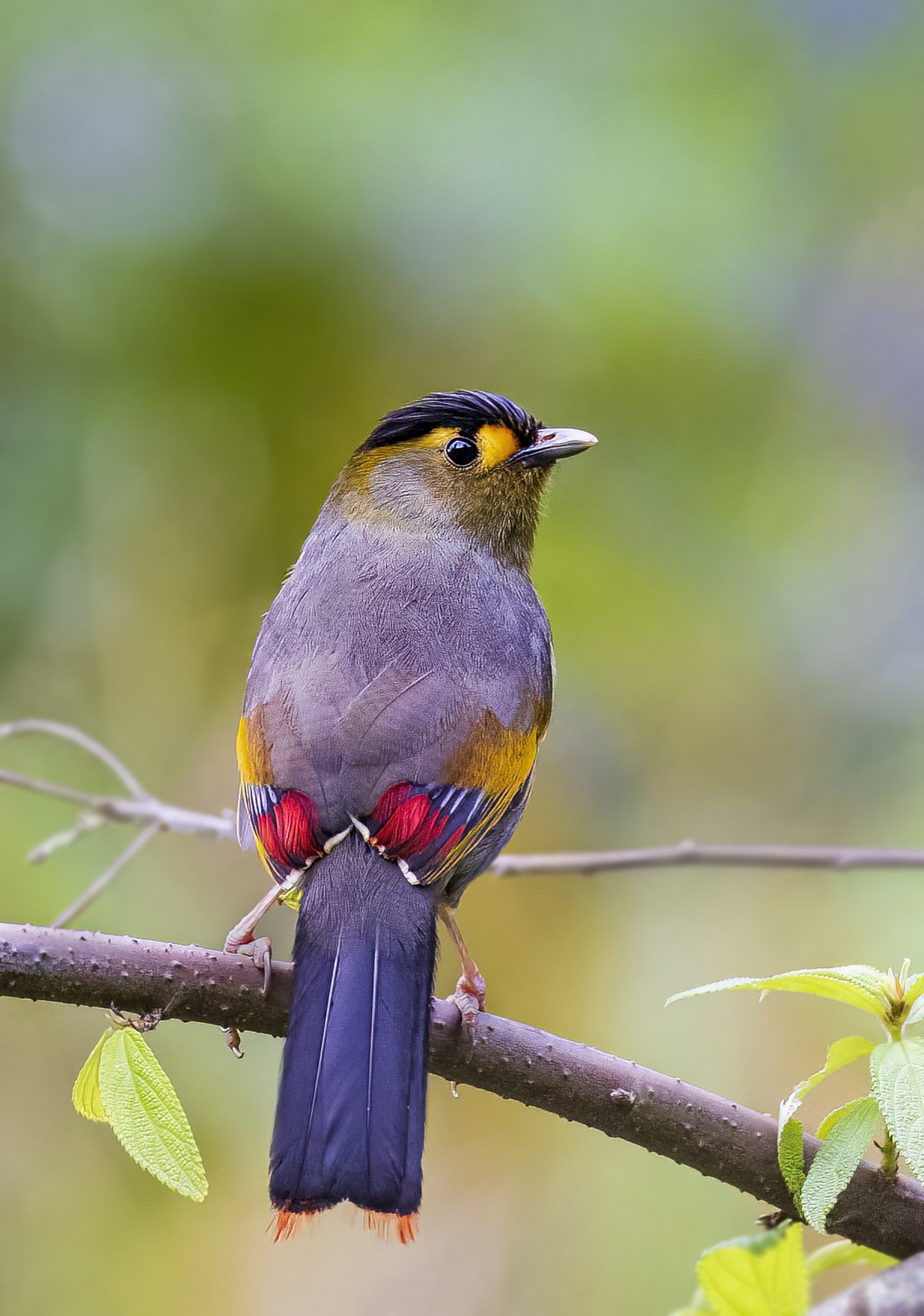
Bugun Liocichla: One of the critically endangered species of birds, it was first discovered in 1995 by physicists-cum-naturalist Ramana Athreya from Singchung Bugun Village Community Reserve (SBVCR) in Tenga Valley of West Kameng district, adjacent to Eaglenest Wildlife Sanctuary in West Kameng district. The bird was officially recognized as a new species in 2006, given the scientific name Liocichla bugunorum, where Liocichla is the genus name and bugunorum after the Bugun tribe in whose community forests the species was discovered. It was also the first bird species to be found from India in 50 years!
They are generally found in the undisturbed zones of forests and on the hilly terrains. These birds are orange-yellow in colour and have red and white patches. Their fluty voice is distinct amongst all birds in the forest.
Politician turned filmmaker Naresh Glow, of the same community, was the first to make a documentary on the rare bird and its conservation which has been nominated for a prestigious environmental film festival to be held in Paris in December. The movie ‘Wildlife in Our Blood’ has been nominated in the Best Film and Best Director category of the 15th International Wildlife Conservation Documentary Film Festival. It has also been selected for screening at the 13th International Kuala Lumpur Eco Film Fest, 2020 to be held from October 8 to 11.
The film talks about the local community of the Bugun village and how the discovery of the bird, shaped their own journey towards community conservation.
It is a difficult to spot bird in SBVCR with olive-green body feathers and yellow brows with hints of red on the underside of tail and wings.
Glow, a three-time MLA from Thrizino-Buragaon Assembly, one of the founders of the SBVCR, is credited with popularizing the rare bird across the world. His idea of the film was to show how locals, especially the members of indigenous tribes have come forward to save the bird and its habitat. The SBVCR had also won India Biodiversity Award 2018 in “Conservation of wildlife species” category for its efforts to conserve the rare critically endangered bird.
Hornbill is the state bird of Arunachal Pradesh whose population is at a decreasing level. Tribals of Arunachal Pradesh used to hunt these birds for beak and feather for making bopiyais (headgear), which has been stopped now. The lower body, neck and head of the male birds are rufous in colour while it is black for the female. All four species—Oriental Pied Hornbill, Rufous-necked Hornbill, Wreathed Hornbill and Great Hornbill – are found in Pakke Tiger Reserve besides in Namdapha National Park.
Though this majestic bird is threatened globally due to habitat loss and hunting by humans, but divisional forest officer Chukhu Loma in-charge of Pakke Wildlife Sanctuary and Tiger Reserve (PWSTR) in East Kameng district, the only hornbill sanctuary in India, in 2002 and Wildlife Trust of India (WTI) had introduced artificial synthetic hornbill beaks as an alternative to prevent killing of hornbills for beaks to adorn the traditional headgear among members of local Nyishi community. Alarmed by these threats, the forest department and WTI, supported by the David Shepherd Wildlife Foundation (DSWF), collaborated in a Rapid Action Project (RAP) to popularise the artificial beak within the Nyishi community.
Moreover, a Hornbill Nest Adoption Programme (HNAP) involving local people was launched to protect the birds which make nest in the periphery of PWSTR to ensure that the eggs are hatched without any human disturbance. The HNAP, a community-based hornbill conservation programme, had celebrated its tenth year of success in 2022.
Rusty-fronted Barwing: This rare species of bird is found in Namdapha National Park. It is more comfortable in temperate forests. Bhutan, China, Myanmar and Nepal are some other places where this bird is found.
Shrike Babbler: These are small birds which are found in Himalayan ranges and descend down the altitude with the advent of winter. They have stout black hook. They are of different species like Pied, Himalayan, Dalat, Green, Cliccking, Trilling and many more. They are not yet endangered species and are found in huge density.
Parrotbill: Originating from East and South East Asia, these birds are mostly found in Namdapha National Park. These small birds with long tail feeds on weeds, grasses and adjust well to the surrounding temperature. Preferring tropical and temperate climate these birds usually don’t migrate. This bird has various species.
Collared Treepie also known as Black-faced Treppie or Black-browed Treppie, these small perching birds have compact body and long tail. While the wings are white, the tail is black in colour. They are mostly found in Haimalayan region like Nepal and Burma. In Arunachal Pradesh, they mainly reside at Namdapha National Park.
Barwing generally found in the Himalayan region of India and countries like China and Taiwan. Arunachal Pradesh is also home to Barwings, which are of various species — Rusty-Fronted Barwing, Taiwan Barwing and Spectacled Barwing.
Blyth’s Tragopan is found in Eaglenest Wildlife Sanctuary (EWS) . these birds generally feed on buds, fruits, berries and seeds. Deforestation is one of the main reason behind the extinction of these birds. They generally migrate in search of food.
White-tailed Robin, a unique bird, is found in EWS and generally live in sub-tropical and tropical moist forests. Other than India, bird enthusiasts can find them in Bangladesh, Nepal, Taiwan, Thailand and Malaysia.
Sunbird: Mostly found in EWS, these birds are almost extinct in India. They are still found in different parts of the world. They generally live in higher altitudes. Other than nectar these birds also feed on spiders and insects. They are classified with humming birds as they can take nectar while hovering.


 20