
By A O News Service
NAHARLAGUN, May 07: Arunachal Pradesh, which once was part of greater Assam and lingua franca of Arunachalees Assamese, cannot be free from the spirit of Bihu, an important cultural festival of Assam, uniquely Assamese to which all communities of Assam had contributed elements.
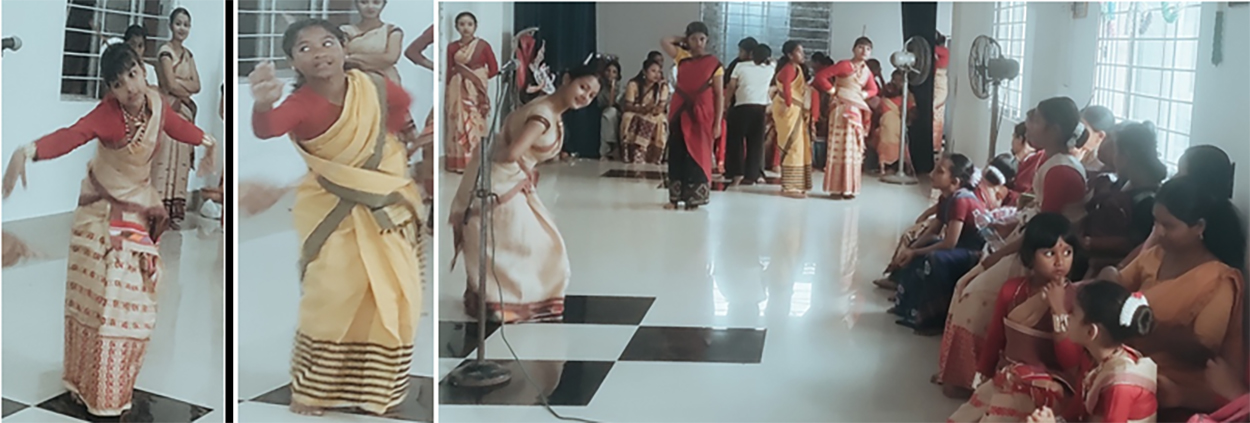
With all preparations are on to celebrate two-day Rongali Bihu from May 10 in a field near Helipad here, four dance teachers, namely Nitumani Gogoi, Bijit Gogoi, Bikash Dutta & Manoj Dutta from North Lakhimpur trained over 50 tiny tots at the initiative of Kristi Kendra Dance Academy. The 10-day training concluded at Kristi Kendra here on Tuesday with the dances in their best traditional attires performing to self sung tunes Bihu Bihu lagiche to the thunderous applause of the gathering family members.
While time tested cultures and traditions are under threat across India due to the impact of modernity, this again gave a louder message that conscious Assamese are passing down their culture to younger generations with commitment.
Bihus are of three types – Rongali or Bohag, observed in April, Kongali or Kati, is the sombre, thrifty one reflecting a season of short supplies and is an animistic festival, observed in October or November and Bhogali or Magh is a harvest festival with community feasts observed in January. But Rongali Bihu celebrated in Mmid-April as Spring Festival is most important and celebrated in mass with greater enthusiasm and traditional fervour.
Bihu is associated with agriculture and rice in particular. Bohag Bihu is a sowing festival, Kati Bihu is associated with crop protection and worship of plants and crops and is an animistic form of the festival, while Bhogali Bihu is a harvest festival.
The Rongali Bihu coincides with the Assamese New Year and as well as with other regions of Indian subcontinent, East Asia and South-East Asia, which follow Hindu and Buddhist calendars. In contemporary times, the Bihus are celebrated by all Assamese people irrespective of religion, caste or creed. It is also celebrated overseas by the Assamese diaspora community living worldwide.
The word Bihu has been derived from Deori (a Boro-Garo language) word Bisu means “excessive joy”. Original form of Bihu continues among the Chutias, Sonwal Kacharis, Thengal Kacharis & Deoris. These groups, known as Sadiyal Kacharis were associated with the historical Kingdom of Sadiya. The other branches of Bodo-Kacharis which include Boros, Dimasas, Rabhas, Tiwas, etc. have also been celebrating Bihu since ancient times.
In local folklore, it is said that Bordoisila (Bardai Sikhla in Bodo) (meaning north-westerly winds in Assamese) was the daughter of God Earth who married to a bridegroom of some distant land. Bordoisila visits her mother’s home once in year during spring time which indicates the beginning of Bihu and leaves after a few days which indicates the end of Bihu. Assam experience strong gale (wind) at that period which marks the beginning of Bihu and another strong gale after her departure which is devastating.
The word Bordoisila is derived from Bodo and Bordaisikhla means “girl of storm” (Sikhla meaning girl and Bardai meaning storm). There is even a dance with the same name performed among Boro people. The first reference of Bihu can be found in the copperplate inscription of Chutia king Lakshminarayan.
The inscription was found in Ghiamara region of Lakhimpur district in 1935 and it was issued in 1401 A.D. It states that the king Lakshminarayan has donated land grants to Brahmins on auspicious occasion of Bihu.


 20

